Quick answer: Chasing losses means gambling more, or betting bigger, to win back money you've already lost. It's one of the nine DSM-5 signs of gambling disorder. To stop, end the session now, treat the lost money as gone, cut off access to cash and betting apps, and call 1-800-MY-RESET for free, confidential help.
Money & debt
Chasing Losses: Why It Happens and How to Stop
By QuitBet Addiction Research Team · Updated · 8 min read
On this page
Chasing losses usually starts with one bad session. You're down $400 on Sunday's early games, so you put $400 on the late game to get back to even. It loses. Now you're down $800, and the only fix you can see is the night game.
If you've caught yourself betting to get even, this is for you. It's also for partners who've watched it happen and want to understand it. If you're in the middle of a chase right now, skip to the steps below.
What does chasing losses mean?
Chasing losses means continuing to gamble, or gambling harder, to recover money you've already lost. A 2023 review in Neuroscience & Biobehavioral Reviews defines loss-chasing as "the tendency to continue and/or intensify gambling following losses" and calls it a key clinical symptom of gambling disorder (Banerjee et al., 2023).
Researchers describe two kinds:
- Within a session, after a loss you keep going, raise your stakes, take riskier bets or play faster. A 2022 study of 2,713 online players found that people played more quickly after losing, which the authors say "may reflect an urge to continue gambling" (Chen et al., 2022).
- Between sessions, you come back another day to win back what you lost. This is the version clinicians use to diagnose gambling disorder (Chen et al., 2022).
The same review found that studies split almost evenly between the two, with 39 measuring chasing between sessions and 38 within a session (Banerjee et al., 2023).
Is chasing losses a sign of a gambling problem?
Yes. Chasing is one of the nine criteria for gambling disorder in the DSM-5, the manual US clinicians use to diagnose it. The criterion reads: "After losing money gambling, often returns another day to get even ('chasing' one's losses)" (DSM-5 criteria, Connecticut DMHAS).
One sign on its own isn't a diagnosis. A clinician looks for four or more of the nine within a 12-month period, and rates it mild (4 to 5), moderate (6 to 7) or severe (8 to 9) (Connecticut DMHAS). But chasing rarely shows up alone. People who chase often also lie about how much they've lost or borrow to cover it. Our guide to the signs of a gambling problem walks through all nine.
One finding surprised us. In a 2024 study of 15,544 people on an online casino, players on most games came back more slowly after a loss, not faster (Zhang et al., 2024). In that data, the average player didn't chase. So if you keep betting to get even, you're doing something most players there didn't, and it's worth taking seriously.
Why do people chase their losses?
People chase because a loss feels like a debt the next bet can repay. Economists Richard Thaler and Eric Johnson found that after losing, people find bets that offer "a chance to break even" especially attractive, which they called the break-even effect (Thaler and Johnson, 1990, Management Science).
The feeling is real. The logic isn't, because the game has no memory of what you lost. Nevada's gaming rules, for example, require that every possible outcome on a slot machine be available on every play (Nevada Regulation 14.040). Being down $500 doesn't make the next spin more likely to pay.
Most chases run on one of these thoughts:
| The chasing thought | What's actually true |
|---|---|
| "I'm due for a win." | Each spin or hand starts fresh. A slot machine in Nevada must keep every outcome possible on every play (Nevada Regulation 14.040). |
| "If I bet bigger, I'll get even faster." | Bigger bets mean bigger expected losses. On American roulette, a $100 bet on red loses $5.26 on average (DePaul University), ten times the roughly $0.53 a $10 bet loses. |
| "I'll stop once I'm back to even." | Being down makes break-even bets feel more attractive than they are (Thaler and Johnson). Even is a moving target once losses grow. |
| "This bet will fix the rent money." | A missed payment is a money problem with money solutions: a call to the lender, a payment plan, free credit counseling. Our gambling debt guide covers them. |
Sometimes a chase works. That's part of what keeps it going. One win after a string of losses feels like proof the method works, and the next losing streak starts from a higher stake.
How do you stop chasing losses?
You stop chasing losses by ending the session, making the money harder to reach and getting support before the next urge. Do the first three steps tonight if you can.
- Stop the session right now. Close the app and log out. If you're at a casino, leave the floor. Waiting gives the urge time to pass, and our free urge timer can help you sit it out.
- Write down the real number. Add up what you lost this session, this month and in total. Our gambling loss calculator does the math. Seeing the full figure helps you treat the money as spent instead of as something you're about to win back.
- Put the money out of reach. Remove saved cards from your phone and betting apps, delete the apps, and ask someone you trust to hold a card for a while. Our gambling blocker finder shows how to block betting sites on your devices.
- Close the accounts and self-exclude. Closing an account removes the easiest way back in. Self-exclusion adds a barrier you can't undo on a bad night. Our guide to deleting a DraftKings account shows what the full process looks like, and the National Council on Problem Gambling's state map lists your state's programs.
- Pay the essentials first. Rent, food, medicine and transport come before any debt from gambling. Never borrow to win back a loss.
- Tell one person. Someone who knows is someone you can text before the next bet. If you're not ready to tell family, call or text 1-800-MY-RESET (1-800-697-3738), the free, confidential National Problem Gambling Helpline (NCPG).
- Get help that addresses the thinking behind it. Cognitive behavioral therapy (CBT) has the strongest evidence base among psychological treatments for gambling problems, according to a 2023 meta-analysis of 29 trials (Eriksen et al., 2023). Our guide to therapy for gambling addiction covers how to find it.
If you want a structure for the week ahead, our free quit gambling plan builds a seven-day plan from a few questions.
What should you do right after a big loss?
Right after a big loss, make no money decisions for 24 hours. Don't deposit, don't move money between accounts and don't take out a loan. The shock and shame you feel tonight are exactly the conditions that make a break-even bet look reasonable.
Instead, get physically away from the app or the casino. Eat something, sleep if you can, and tell someone what happened. In the morning, look at the number with a clearer head and start with the steps above.
Write down in advance what you'll do the next time the urge to chase hits. Our free urge plan worksheet has room for your warning signs, the people you'll call and what you'll do instead.
If the loss leaves you feeling hopeless or thinking about ending your life, call or text 988 for the Suicide & Crisis Lifeline right now.
How can an app help when you want to chase?
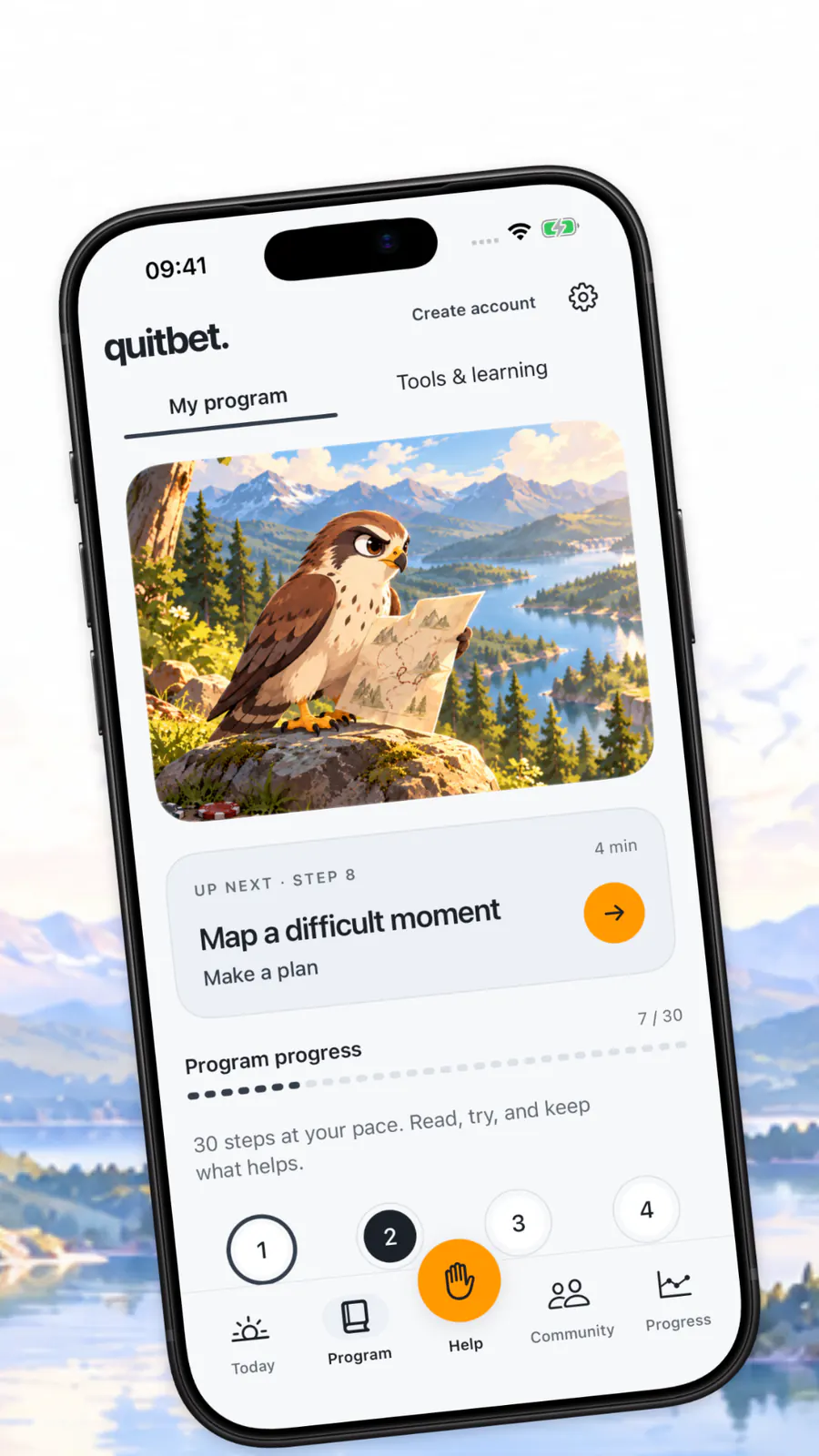
An app can't undo a loss, but it can put a pause between the urge and the bet. QuitBet, for iPhone (iOS 18 or later) and Android, blocks gambling apps and sites: through Apple's Screen Time on iPhone, and with an on-device filter and app blocking on Android. When the urge to chase hits, its urge tools offer short breathing and focus exercises, and its AI chat is there for support at 2am.
QuitBet also tracks money saved and your streak, so the number you watch climbs instead of the one you're trying to win back. It has daily check-ins on urges and triggers, a Learn section and a community of people who are quitting too. It's free to start and works alongside therapy or Gamblers Anonymous, not in place of them.
FAQ
Is chasing losses a sign of gambling addiction?
Yes. Returning another day to win back lost money is one of the nine DSM-5 criteria for gambling disorder. A diagnosis needs four or more criteria in 12 months, so chasing alone isn't a diagnosis, but it's a strong reason to take a closer look and to talk to someone.
Why can't I stop chasing my losses?
After a loss, bets that offer a chance to break even feel more attractive than they really are. Researchers call this the break-even effect. Add shame and a bill you can't cover, and the urge gets loud. Blockers, self-exclusion and handing over a card don't depend on how you feel at midnight. Willpower does.
Can you ever win back your gambling losses?
Sometimes a single bet wins, and that's what keeps chasing going. Over time the odds favor the house, and bigger bets mean bigger expected losses. The money you've lost is gone. The money you still have is what you can protect.
What's the difference between chasing losses and chasing wins?
Chasing losses means betting more to recover money you lost. Chasing wins means betting more after winning to keep a streak going. A 2024 study of an online casino found clear signs of win chasing and only limited evidence of loss chasing on average, so if you chase losses again and again, you're doing something most players in that data didn't.
Should I borrow money to win back what I lost?
No. Borrowing to gamble turns a loss into a debt with interest and adds a deadline that makes the next chase more desperate. Relying on others for money to cover gambling is itself one of the DSM-5 signs. Start with your essentials and the steps in our gambling debt guide instead.
Who can I talk to about chasing losses?
Call or text 1-800-MY-RESET (1-800-697-3738), the National Problem Gambling Helpline. It's free, confidential and open 24/7, by call, text or online chat. Gamblers Anonymous meetings are another free option.
Need to talk to someone right now? Call or text 1-800-MY-RESET (1-800-697-3738), or chat online, to reach the National Problem Gambling Helpline. It's free and confidential, and it's open 24/7. If you're having thoughts of suicide, call or text 988.
The QuitBet app
Keep your daily plan close
QuitBet for iPhone and Android brings your quit plan, check-ins, gambling blocking and urge tools together.
- Quick help for the moment an urge hits
- Daily check-ins, streaks and money saved
- A blocker for gambling apps and websites
- A community of people quitting too

On a computer?Scan with your phone camera to get QuitBet on iPhone or Android.
Rated 4.4 on the App StoreFree to start on iPhone and Android.