Quick answer: Therapy for gambling addiction is usually outpatient counseling, most often cognitive behavioral therapy (CBT), which has the strongest research support. A course often runs about 6 to 12 sessions, in person or by video. Some states, including North Carolina and California, offer it at no cost, and 1-800-MY-RESET can point you to help where you live.
Getting help
Therapy for Gambling Addiction: Types, Costs and How to Find Free Help
By QuitBet Addiction Research Team · Updated · 12 min read
On this page
- What is therapy for gambling addiction, and does it work?
- What happens in the first gambling therapy session?
- What does a typical course of CBT for gambling look like?
- How much does gambling counseling cost, and is there free counseling?
- Can you do gambling therapy online?
- How do you find a gambling therapist near you?
- What should you ask a gambling therapist before you start?
- How does therapy compare with GA, rehab and apps?
- Can medication help alongside therapy?
- What can you do between therapy sessions?
- FAQ
If you're reading this after a bad loss, you're already ahead of most people with a gambling problem. The American Psychiatric Association says only one in ten people with gambling disorder seek treatment.
What is therapy for gambling addiction, and does it work?
Therapy for gambling addiction is talk treatment with a trained counselor who helps you change how you think about betting, handle urges and rebuild your money and relationships. It helps many people. The catch, according to the research, is that the gains can fade once sessions stop.
The American Psychiatric Association lists CBT, psychodynamic therapy, group therapy and family therapy as the main types used for gambling disorder.
What CBT for gambling addiction involves
CBT for gambling addiction usually covers what triggers your betting and what it costs you, ways to handle urges, other things to do with that time, and a plan for slips. A 2023 review describes these parts, plus "stimulus control," such as limiting how much money you can reach (Pfund et al., 2023). In practice, you learn to catch thoughts like "I'll win it back" and plan for payday or a big game.
What the research says about CBT
The same review pooled 29 studies with 3,991 people. Right after treatment, CBT clearly reduced how severe the gambling problem was and how often people gambled. At later follow-up, the effect was no longer statistically significant, and the authors said the early results are probably overestimated because of publication bias (Pfund et al., 2023).
A second 2023 review of 29 randomized trials of psychological treatments found a medium drop in gambling severity. CBT had the strongest evidence base and face-to-face therapy did best. The authors also rated the risk of bias as generally high and said long-term effects are still unclear (Eriksen et al., 2023).
Our read: therapy is worth doing, but plan how you'll keep the gains after the last session, with a support group, a blocker or check-ins with someone you trust.
Other types of gambling therapy
| Approach | What it involves | What the evidence says |
|---|---|---|
| Motivational interviewing (MI) | Guided conversations that build your own reasons to change | Mixed. A 2015 review found less frequent gambling for up to a year (Yakovenko et al.); a 2025 review of 7 trials found results close to control groups (Forman et al.) |
| MI combined with CBT | MI to build commitment, then CBT skills | A 2026 review of 8 trials found the combination beat CBT alone right after treatment, but not at follow-up (Hastings et al.) |
| Group therapy | A counselor leads a small group through the same skills | UK guidance offers group CBT first, or individual CBT if a group doesn't suit you (NICE NG248) |
| Family or couples therapy | Sessions that include a partner or relative | Used in practice (APA); NICE says to involve family only if you both agree |
What happens in the first gambling therapy session?
The first session is mostly an assessment: the counselor asks how your gambling started, how it affects you now and what you want to change. You don't need a polished story.
The UK's national guideline (NICE NG248, January 2025) lists what an assessment should cover. US clinics vary, but expect questions about:
- When you started, what you bet on and how often you gamble now.
- Your physical and mental health, including alcohol or drug use.
- Any thoughts of suicide, now or in the past.
- What gambling has cost you, and whether you've borrowed to gamble.
- How it affects your relationships and work.
- What triggers your urges and what gambling does for you, such as escape or relief.
Many counselors also use a short questionnaire, such as the Problem Gambling Severity Index.
Bring rough numbers if you can. Our gambling loss calculator turns deposits and withdrawals into a net figure, so you're not guessing in the room.
Early on, you and the counselor agree on a goal. NICE says it's typically to stop gambling, alongside goals like easing money problems. If suicide risk comes up, the counselor should make a safety plan with you. If you're having those thoughts now, call or text 988 rather than waiting for an appointment.
What does a typical course of CBT for gambling look like?
A typical course is weekly sessions for about two to three months. NICE says CBT usually runs 6 to 8 individual or 8 to 10 group sessions, sometimes more. Telehealth provider Birches Health builds its program around a 12-week schedule.
Sessions often move through these stages:
- Assessment and goals.
- Mapping triggers, such as payday, boredom or a game on TV.
- Urge skills: delaying, calling someone and riding the urge out.
- Money safeguards. NICE lists blocking software, self-exclusion, bank gambling blocks and limiting access to cash, for example by having a family member handle finances for a while.
- Challenging gambling thoughts, such as believing a win is due.
- Relapse prevention, so a slip doesn't turn into a binge.
Expect homework, like logging urges. If debt is a big part of the picture, our gambling debt guide has steps and a call script you can bring to therapy.
How much does gambling counseling cost, and is there free counseling?
It can be free through a state program. If you pay out of pocket, one national telehealth clinic lists $165 to $195 a session. Check what your state funds before you pay anything.
Free gambling counseling through state programs
Some states pay for gambling treatment, often from lottery or gaming revenue. These are examples we checked on official pages in October 2026:
| State | What it covers | How to start |
|---|---|---|
| North Carolina | Up to 12 no-cost sessions, in person or remote, for you or affected family and friends (state brochure) | Call 877-718-5543 or text morethanagamenc to 53342 (More Than a Game NC) |
| California | CalGETS: no-cost outpatient, group, intensive outpatient and 30-day residential care (CDPH) | Use the CalGETS provider directory on the same page |
| Pennsylvania | Low-cost or no-cost treatment for you and your family members (PA Responsible Play) | Search providers by county, including telehealth (DDAP) |
| Maryland | No-cost counseling for residents, regardless of insurance or ability to pay (Maryland Center of Excellence on Problem Gambling) | Use the counselor finder on that site |
| Arizona | State-subsidized treatment for gamblers and anyone affected; phone or telehealth at some providers (Arizona Division of Problem Gambling) | Ask a listed provider about the state-funded TAP program, or call 1-800-NEXT-STEP |
| Oregon | The state helpline refers residents to free, confidential counseling (Oregon Problem Gambling Resource), funded from Oregon Lottery revenue (Oregon Health Authority) | Call 1-877-MY-LIMIT |
Not in one of these states? NCPG's help-by-state page links to resources for every state, and 1-800-MY-RESET can tell you what's funded where you live.
Does insurance cover gambling therapy?
Sometimes. Gambling disorder is a recognized mental health diagnosis according to NCPG. Whether your plan pays for it is a separate question, and the answer varies by insurer and state.
Call the number on your insurance card and ask whether your plan covers outpatient treatment for gambling disorder, which in-network counselors treat it, and what you'll pay per session.
What telehealth gambling therapy costs
Two national telehealth services publish cost details (these are the companies' own claims):
- Birches Health says it's in-network with plans including BCBS, UnitedHealthcare, Aetna, Cigna, Anthem and TRICARE, and that many clients pay $0 to $25 per session depending on their plan. It doesn't post a self-pay price.
- Kindbridge Behavioral Health starts with a free 15-minute intake call. Its pricing page lists $165 for individual therapy and $50 for a therapy group, while its insurance page lists $195 for a single session. Ask for a written quote.
Can you do gambling therapy online?
Yes. Online gambling counseling by video or phone is available across the US. Birches Health says its sessions are fully virtual in all 50 states, and Kindbridge lists therapists based in 49 states and Puerto Rico. North Carolina, Pennsylvania and Arizona list remote options, and one California intensive program runs over Zoom or phone.
Remote treatment has decent evidence behind it. When Sagoe and colleagues (2021) pooled 13 trials of internet-delivered programs, symptoms went down, and the effect was bigger when a therapist was involved than when people worked through a program alone. NICE notes the tradeoff: video is more convenient, while in-person sessions are more likely to build a strong working relationship with your counselor.
How do you find a gambling therapist near you?
The fastest route is to call or text 1-800-MY-RESET and ask for gambling counseling where you live. NCPG says its helpline is a hub that connects you to local resources in every state.
To find a gambling addiction therapist:
- Check your state's program first, since it may be free.
- Search NCPG's counselor directory, which links to certified gambling counselors. NCPG says the list isn't complete and isn't an endorsement.
- Search the IPGGC certification directory by country, region or certification.
- Ask your insurer for in-network counselors who treat gambling disorder.
- If nobody nearby fits, try video sessions.
What does a gambling counselor certification mean?
ICGC stands for International Certified Gambling Counselor, a voluntary credential from IPGGC, formerly the International Gambling Counselor Certification Board (IGCCB).
For the first level, ICGC-I, a counselor needs a degree or license in a behavioral health field, 30 hours of gambling-specific training, 100 hours of clinical work with gamblers or their families, consultation with an approved supervisor and a passing exam. A licensed therapist without it can still be a good fit if they've treated many gambling clients.
What should you ask a gambling therapist before you start?
Ask about gambling experience, approach, cost and what happens between sessions. Direct questions on a first call are normal.
- How many people with gambling problems have you treated?
- Are you certified in gambling counseling (ICGC) or trained in gambling-specific CBT?
- Which approach do you use, and about how many sessions do you expect?
- Are you licensed in my state? This matters for video sessions.
- Do you take my insurance or state funding? What will I pay per session, and is there a late-cancellation fee?
- Will we work on money safeguards and debt, and can you refer me to a credit counselor?
- Can my partner or family join some sessions, or get support of their own?
- What should I do if I slip between sessions?
- Will you work alongside Gamblers Anonymous, a doctor or the tools I use at home?
If telling your partner is part of the work, see how to tell your partner about gambling.
How does therapy compare with GA, rehab and apps?
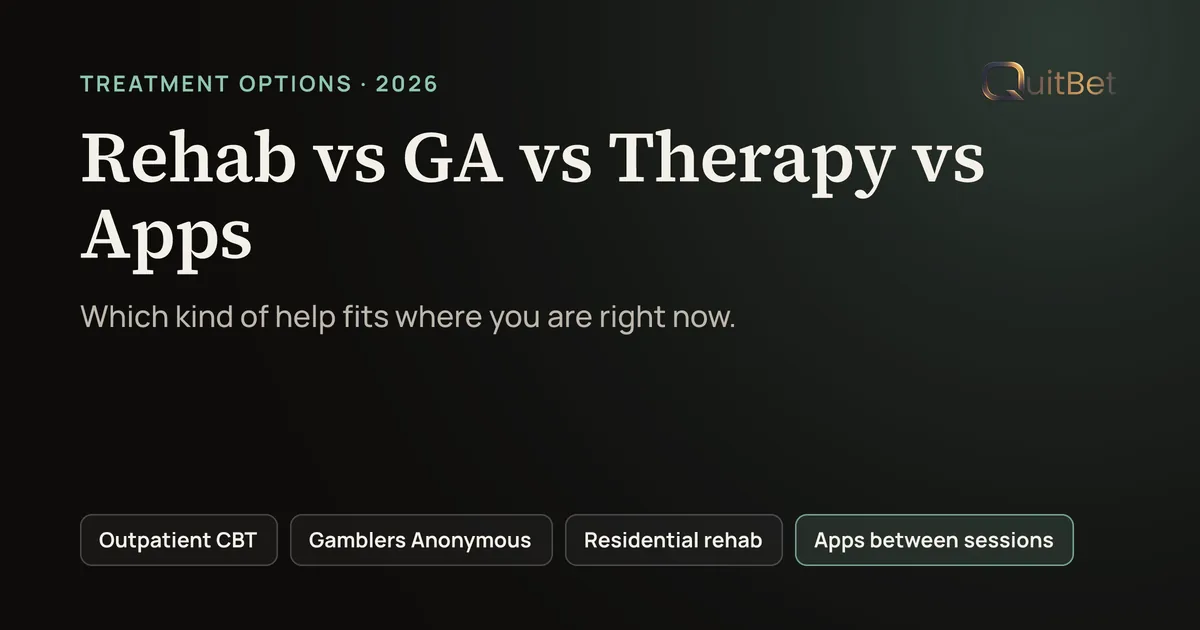
Therapy is the most studied option. GA, rehab and apps each do a different job, and many people combine two or three. For the full decision, including when residential care makes sense, read our rehab vs. GA vs. therapy comparison.
| Option | What it is | Cost | Role |
|---|---|---|---|
| Therapy | Weekly sessions with a trained counselor, in person or by video | Free in some states; otherwise insurance or self-pay | Best-studied treatment; protect the gains afterward |
| Gamblers Anonymous | Peer meetings in person, online or by phone | No dues or fees | Ongoing peer support at any stage; research is mixed |
| Residential rehab | Living at a center for about a month | Rarely published; no cost through California's CalGETS | For people who keep relapsing or have other serious needs |
| Apps and blockers | Blocking, check-ins and urge tools on your phone | Varies; QuitBet is free to start | Support between sessions; not a treatment on their own |
Our Gamblers Anonymous guide explains what a first meeting is like.
Can medication help alongside therapy?
Possibly, but no medication is approved for this. The APA says there are no FDA-approved medications to treat gambling disorders, though some can treat depression or anxiety that comes with it.
A 2025 analysis of 16 trials found nalmefene reduced gambling severity compared with placebo. Naltrexone's effect on severity was smaller and not statistically significant, though it improved quality of life. Both led to more dropouts from side effects (Ioannidis et al., 2025). NICE suggests a specialist consider naltrexone when therapy alone hasn't worked.
Talk to a doctor or psychiatrist before trying anything, and bring a list of what you already take. NICE notes that some medicines, including aripiprazole and drugs for Parkinson's disease, may contribute to gambling problems.
What can you do between therapy sessions?
You spend far more hours between appointments than in them, so plan for that time. Agree with your counselor on what to track. Free tools on our site:
- The personal urge plan worksheet for triggers and who to call.
- The 30-day recovery calendar for check-ins you can show your counselor.
- The quit-gambling checklist for accounts, blockers and money.
- The 10-minute urge timer and the gambling blocker finder.
These are planning aids, not treatment.
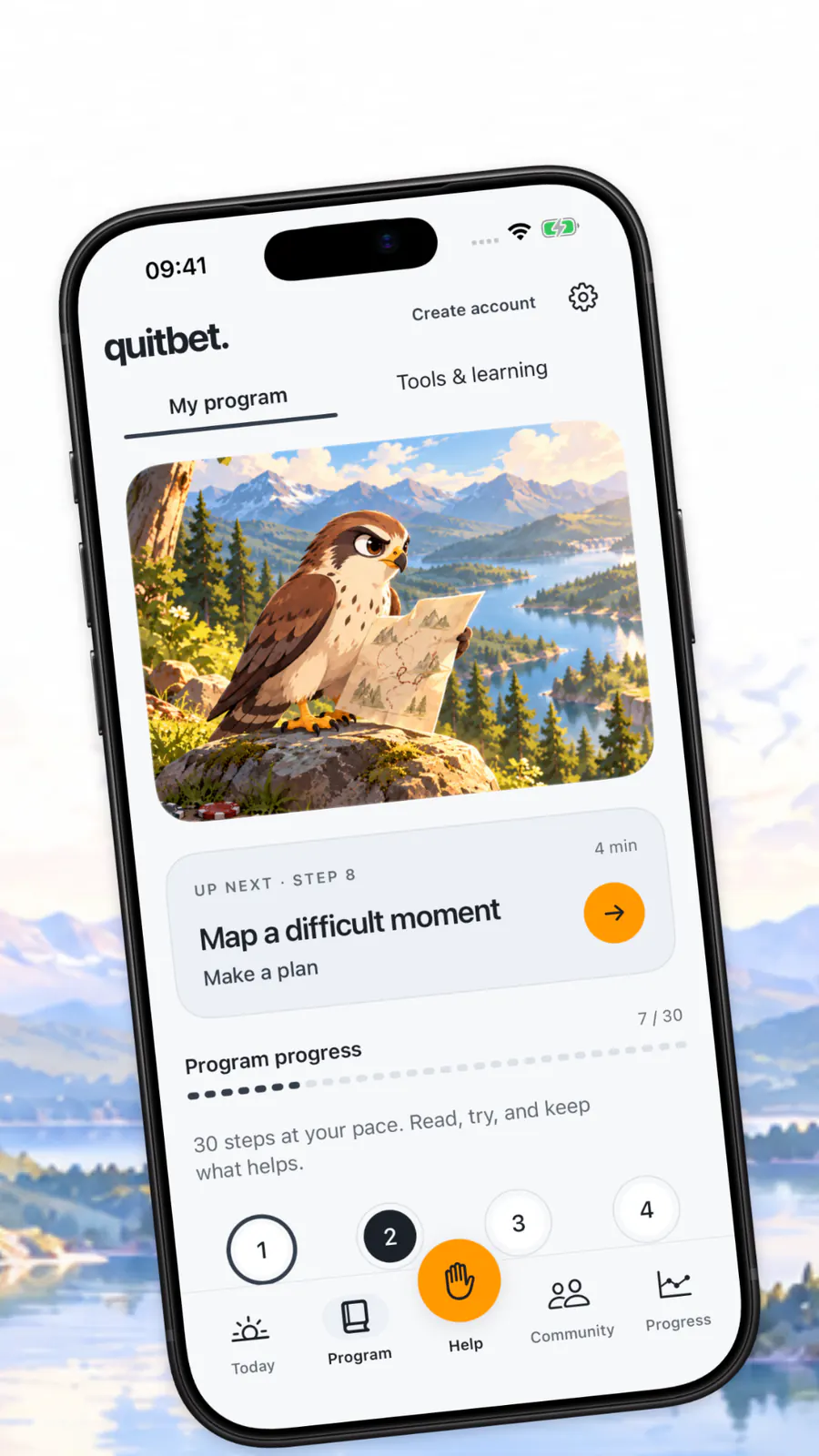
QuitBet is an iPhone app (iOS 18 or later) that works alongside therapy, not in place of it. It combines a personalized quit plan, daily check-ins, a panic button, an AI coach, Screen Time blocking, a Learn section and a recovery community, and it's free to start. Your check-ins give you something concrete to discuss in session. See our guide to apps for quitting gambling for other options, and our first-day plan for what to do while you wait for an appointment.
FAQ
Is there free counseling for gambling addiction?
Yes, in some states. North Carolina covers up to 12 no-cost sessions, and California and Maryland offer no-cost counseling to residents. Call or text 1-800-MY-RESET to find out what your state funds. Gamblers Anonymous has no dues or fees.
Does insurance cover gambling therapy?
It depends on your plan. Gambling disorder is a recognized mental health diagnosis, and telehealth providers such as Birches Health say they're in-network with major insurers. Call your insurer and ask whether outpatient gambling treatment is covered and what you'll pay per session.
How many sessions of therapy for gambling do you need?
Many courses run about 6 to 12 sessions. UK guidance suggests 6 to 8 individual or 8 to 10 group CBT sessions, and North Carolina's program covers up to 12. Some people need more.
Can I do gambling therapy online?
Yes. Birches Health and Kindbridge offer gambling therapy by video, and several state programs include telehealth or phone counseling. Trials of internet-delivered programs found they reduced gambling symptoms, especially with a therapist involved.
What is the best therapy for gambling addiction?
CBT has the most research support. Its effects are clearest right after treatment and less certain later, so pair it with ongoing support. Evidence for motivational interviewing on its own is mixed.
Can my family get counseling too?
Often, yes. North Carolina, Arizona and Pennsylvania all extend state-funded treatment to family members or others affected by someone's gambling. Gam-Anon runs free peer meetings for families.
Do I have to stop gambling before I start therapy?
No. You can start while you're still gambling. You and your counselor agree on a goal together, and UK guidance says that goal is typically to stop.
Need to talk to someone right now? Call or text 1-800-MY-RESET (1-800-697-3738), or chat online, to reach the National Problem Gambling Helpline. It's free and confidential, and it's open 24/7. If you're having thoughts of suicide, call or text 988.
The QuitBet app
Keep your daily plan close
QuitBet for iPhone brings your quit plan, check-ins, gambling blocking and urge tools together.
- A panic button for the moment an urge hits
- Daily check-ins, streaks and money saved
- A blocker for gambling apps and websites
- A community of people quitting too
Download on the App Store
On a computer?Scan with your iPhone camera to get QuitBet.
Rated 4.4 on the App StoreFree to start on iPhone.