Quick answer: The main signs of a gambling problem are betting more to get the same thrill, chasing losses, lying about gambling, failing to cut back, feeling restless when you try, and needing others to cover money trouble. A clinician can diagnose gambling disorder when four or more of nine signs show up within 12 months.
Quitting gambling
Signs of a Gambling Problem: 9 Warning Signs and What to Do
By QuitBet Addiction Research Team · Updated · 11 min read
On this page
- What are the signs of a gambling problem?
- How many signs mean you have gambling disorder?
- What are the most common gambling addiction symptoms in daily life?
- What do the warning signs look like with sports betting and online apps?
- How can you tell if someone else has a gambling problem?
- Why is gambling addictive?
- Is gambling an addiction?
- Am I addicted to gambling? A short self-check
- When do the signs mean you need help right away?
- What should you do if you see the signs?
- FAQ
If you're asking whether your betting has gone too far, the signs of a gambling problem below will help you answer honestly. We cover the nine signs clinicians use, how they show up in daily life and on betting apps, why gambling is hard to stop, and what to do next.
Only a licensed clinician can diagnose gambling disorder, and nothing here is a test. If several signs fit, talk to someone. That's all a list like this can tell you.
What are the signs of a gambling problem?
The signs of a gambling problem are a pattern of gambling you can't control that keeps causing harm, such as chasing losses, hiding bets and borrowing to cover them. Clinicians in the US use the nine criteria for gambling disorder in the DSM-5, the American Psychiatric Association's diagnostic manual.
Here they are in our own words. The American Psychiatric Association describes them for patients, and the Nevada Council on Problem Gambling reproduces the official wording.
| # | The sign, in plain English | What it can look like |
|---|---|---|
| 1 | You need bigger bets to get the same excitement | $20 bets felt fun last year; now nothing under $100 does |
| 2 | You feel restless or irritable when you try to cut back or stop | Snapping at your kids on the first night without betting |
| 3 | You've tried to control, cut back or quit, and it keeps not working | Deleting the app on Sunday and reinstalling it by Wednesday |
| 4 | Gambling takes up a lot of your thinking | Replaying old bets, planning the next one, working out where the money will come from |
| 5 | You gamble when you feel stressed, anxious, guilty or low | Opening a casino app after a fight or a bad day at work |
| 6 | You go back to win back what you lost | "I'll get it back tomorrow" after a losing night |
| 7 | You lie to hide how much you gamble | Telling your partner you lost $50 when it was $500 |
| 8 | Gambling has put a relationship, job, or school or career chance at risk, or cost you one | Missing shifts, or a partner who no longer trusts you |
| 9 | You rely on other people to get you out of money trouble caused by gambling | Asking a parent to cover rent "just this once" |
Researchers often describe chasing losses, sign 6, as a defining feature of gambling disorder, though a 2022 lab study found chasing within a single session was more complicated than that picture suggests.
How many signs mean you have gambling disorder?
A clinician can diagnose gambling disorder when you meet four or more of the nine criteria within a 12-month period and the gambling causes real distress or problems in your life. The DSM-5 also rates severity by how many criteria you meet (Nevada Council on Problem Gambling):
| Criteria met in the past 12 months | Severity |
|---|---|
| 4 to 5 | Mild |
| 6 to 7 | Moderate |
| 8 to 9 | Severe |
The clinician also checks that a manic episode doesn't better explain the gambling. That's one reason a checklist can't diagnose you on its own.
The threshold used to be higher. The DSM-5, published in 2013, lowered it from five criteria to four, dropped an "illegal acts" criterion and set the 12-month time frame (Stinchfield et al., 2016).
Fewer than four signs can still mean gambling is hurting you. The National Council on Problem Gambling (NCPG) estimates that about 2.5 million US adults (1%) meet criteria for a severe gambling problem in a given year, and another 5 to 8 million have mild or moderate problems.
What are the most common gambling addiction symptoms in daily life?
The most common gambling addiction symptoms show up as money you can't account for, gambling that takes over your time and attention, and mood changes tied to winning and losing. Many people notice the money first.
Money signs
- Rent, bill or grocery money has gone on bets.
- You've taken cash advances, payday loans or new cards to keep betting or cover losses.
- You hide statements, or keep an account your family doesn't know about.
To see the real number, our gambling loss calculator turns deposits and withdrawals into a net total. If the debt is already serious, our gambling debt guide covers the first steps.
Behavior signs
- Gambling at work, in the bathroom, or in bed when you should be asleep.
- Skipping friends, hobbies or family time to gamble.
- Breaking your own rules ("only on weekends", "only $50") again and again.
Emotional signs
- Feeling irritable or on edge when you can't gamble. Our guide to gambling withdrawal symptoms explains this restlessness and how to plan for it.
- Shame or panic after a session.
- Feeling hopeless about money or the future.
What do the warning signs look like with sports betting and online apps?
On betting apps, the warning signs of gambling addiction often look like secrecy around your phone, more accounts and more in-game bets. They're the same nine signs, just in app form.
- Turning off sportsbook notifications, keeping apps in a hidden folder or deleting promo emails before anyone sees them. That's sign 7, hiding how much you gamble.
- Opening accounts with more and more sportsbooks. In a survey of 1,813 Australian sports bettors, the number of accounts held with different betting companies was higher in every at-risk group than among people with no gambling problems (Russell et al., 2019). The study shows a link, not a cause.
- Placing in-game bets to win back a losing pregame bet is chasing (sign 6). In a 2020 survey of 500 Australian online sports bettors, people who bet in-play scored higher on a standard problem gambling scale, on average 8.76 versus 3.68 (Gainsbury et al., 2020). The authors note their cross-sectional data can't show cause.
- Increasing a deposit limit you set yourself, or using a bonus to keep going after you meant to stop.
- Refreshing lines at work or at 2 a.m. is sign 4, preoccupation.
If online betting is your main problem, our guide to how to stop online gambling covers closing accounts and blocking apps.
How can you tell if someone else has a gambling problem?
You can often tell from money and secrecy before you ever see a bet: unexplained debt, missing money or valuables, secrecy about bills, and requests to borrow. The Maryland Center of Excellence on Problem Gambling lists these warning signs for families, along with mood changes and pulling away from family and friends.
At home, that can look like:
- Bills going unpaid even though income hasn't changed.
- Defensive or angry reactions when money comes up.
- Requests for loans for reasons that keep changing.
You don't need proof to start a calm conversation. Our guide on how to help someone with a gambling problem covers what to say and how to protect your own money.
Why is gambling addictive?
Gambling is addictive mainly because the rewards are unpredictable: you never know which bet will pay, and that uncertainty keeps people playing. Game design and the urge to win back losses add to the pull.
Unpredictable rewards
Psychologists call this variable-ratio reinforcement. B.F. Skinner argued that unpredictable rewards were central to gambling's appeal, and researchers have used this schedule in animal studies as a model of slot machine play (Zack et al., 2014). Animal work only explains part of it, though.
Near misses
A near miss, like two jackpot symbols and the third just off the line, pays nothing but can feel close to a win. In a 2009 study, near misses made volunteers want to keep playing and activated brain areas that also responded to real wins (Clark et al., 2009). The 40 behavioral and 15 brain-scan participants weren't regular gamblers.
Losses disguised as wins
On multi-line slot machines, you can "win" less than you bet, and the machine still flashes and plays sounds. In a study of 40 novice players, these losses disguised as wins caused about the same physical arousal, measured by skin response, as real wins (Dixon et al., 2010).
Chasing and escape
After a loss, betting again to get even can feel like the only way out. Gambling can also feel like a break from stress or low mood. Both patterns, chasing and gambling when distressed, are among the official criteria (APA).
Medications can play a part
Some medicines that affect impulse control have been linked to gambling problems. UK guidance from NICE (NG248) names dopamine agonists used for Parkinson's disease and the antipsychotic aripiprazole. If you take one of these and gambling started or got worse, tell your doctor. Don't stop or change any medication without talking to the prescriber first.
Is gambling an addiction?
Yes. Gambling disorder is officially classified as an addiction in both major diagnostic systems. The DSM-5, published in 2013, moved it from the impulse control disorders into the chapter on substance-related and addictive disorders (Stinchfield et al., 2016).
The APA says the change reflects research showing gambling disorder is similar to substance-related disorders in how it looks clinically, its brain origins, co-occurring conditions, physiology and treatment. A 2017 review of the brain research reached the same conclusion: the evidence favors grouping it with addictions (Fauth-Bühler et al., 2017).
The World Health Organization's ICD-11 lists gambling disorder as 6C50, under "disorders due to addictive behaviours". WHO describes three core features: impaired control, gambling taking priority over other parts of life, and continuing despite harm.
If someone told you it's "just a lack of willpower", the diagnostic manuals disagree. NCPG calls gambling disorder a recognized mental health diagnosis, and it can be treated.
Am I addicted to gambling? A short self-check
Answer these honestly, thinking about the past 12 months. There's no score. This is a prompt to get help, and it can't diagnose anything.
- Have I bet more, or more often, than I meant to?
- Have I hidden how much I gamble from someone close to me?
- Have I gone back to win back money I lost?
- Have I tried to cut back and found I couldn't?
- Have I needed someone else's money to fix a problem gambling caused?
- Do I feel on edge, low or panicky when I can't gamble?
If any of these fit, talk to someone. For a more structured check:
- Connecticut's addiction services department shares the Brief Biosocial Gambling Screen, a three-question screen published by Gebauer, LaBrie and Shaffer in 2010. A "yes" to any question means a fuller assessment is a good idea.
- NCPG offers a 10-question online self-assessment. NCPG notes this self-administered version hasn't been fully validated yet.
- Gamblers Anonymous publishes its 20 Questions, written from members' experience rather than as a clinical tool.
None of these replaces an assessment. A clinician asks about your gambling, your physical and mental health, and how gambling affects your money and relationships, as UK guidance from NICE describes.
When do the signs mean you need help right away?
Get help today if you're having thoughts of suicide, can't cover basic needs, or are thinking about taking money that isn't yours. Call or text 988 for the Suicide & Crisis Lifeline, or call 911 if you're in immediate danger.
Thoughts of suicide are common with gambling problems. A 2024 analysis of 107 studies found that about 31.6% of people with gambling problems had thought about suicide at some point and 13.2% had made an attempt (Kristensen et al., 2024). The authors note that few studies followed people over time, which limits what anyone can say about cause. If that's where you are right now, call or text 988 tonight. The money questions can wait.
What should you do if you see the signs?
Pick one step and do it today. The rest can wait until tomorrow.
- Call or text 1-800-MY-RESET. The National Problem Gambling Helpline is free, confidential and open 24/7, and it can point you to help in your state.
- Cut off access. Close or self-exclude your accounts and block betting apps. Our first-day plan for how to stop gambling walks through it.
- Tell one person. Pick someone you trust and say it plainly: "I think I have a gambling problem and I want help."
- Get an assessment. Talk to a doctor or a licensed counselor. Bring a list of your medications. Our guide to therapy for gambling addiction explains free state programs and what the first session covers.
- Plan for the next urge. Use the 10-minute urge timer, build a seven-day quit plan or print the personal urge plan worksheet. These are planning aids, not treatment.
- Protect your money. UK guidance from NICE lists safeguards such as bank gambling blocks and limiting your access to cash, for example by letting someone you trust handle finances for a while.
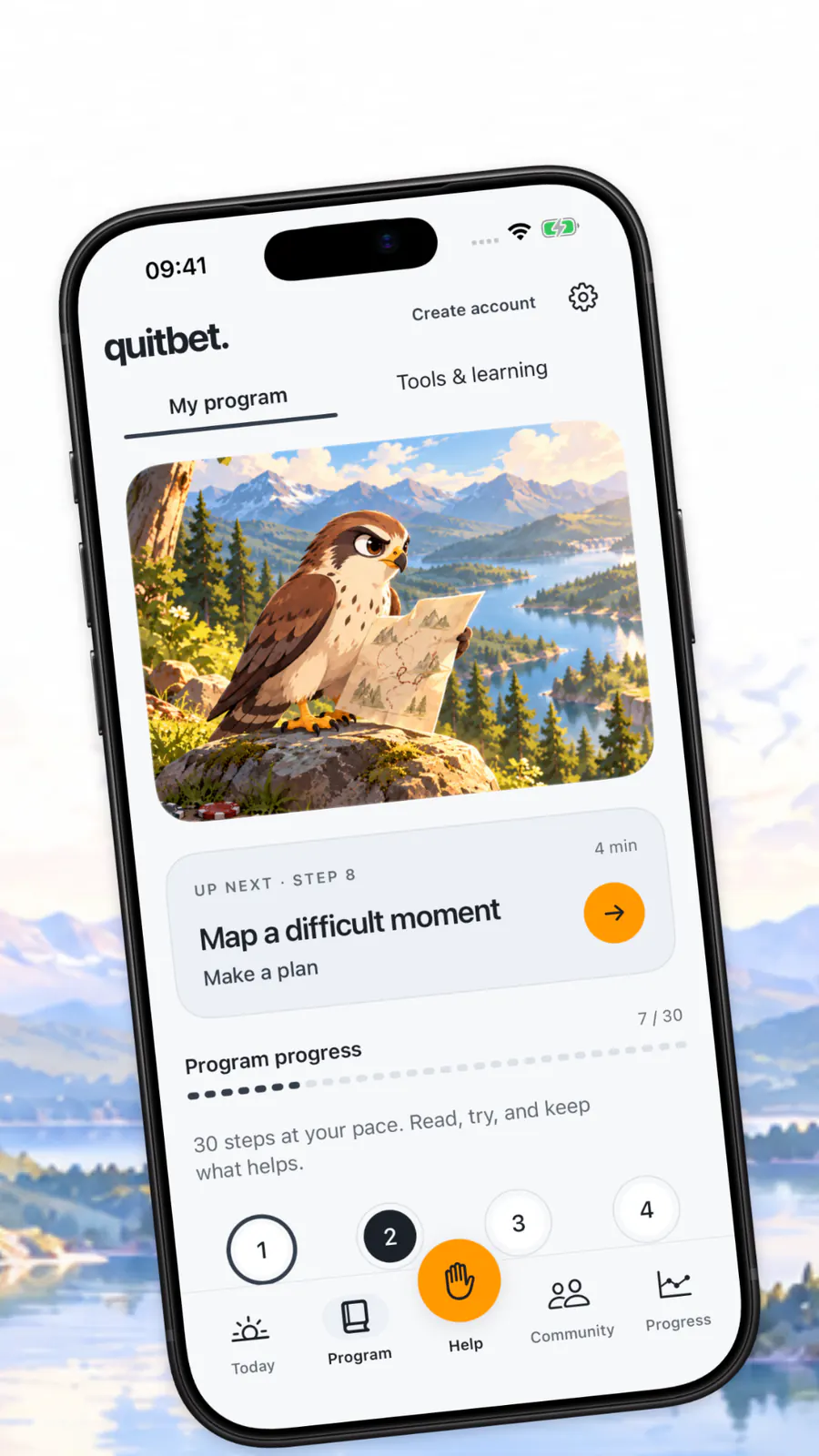
QuitBet is an iPhone app (iOS 18 or later) for the days in between. It combines Screen Time blocking for gambling apps and betting sites, a personalized quit plan, daily check-ins, a panic button and urge exercises, an AI coach, a Learn section and a recovery community, and it's free to start. It works alongside therapy, Gamblers Anonymous or treatment, and it doesn't cure a gambling problem.
FAQ
Is gambling addiction a mental illness?
Gambling disorder is a recognized mental health diagnosis. The DSM-5 groups it with substance-related and addictive disorders, and the WHO's ICD-11 lists it as a disorder due to addictive behaviours. It can be treated, most often with counseling.
How many signs do you need to have gambling disorder?
Under the DSM-5, a clinician looks for four or more of nine criteria within 12 months, along with real distress or harm. Four or five is rated mild, six or seven moderate and eight or nine severe. Only a licensed clinician can make the diagnosis.
Can you have a gambling problem if you win more than you lose?
Yes. The criteria are about control and harm, such as lying, chasing and failed attempts to cut back, not about whether you're up or down overall.
Can an online quiz tell me if I'm addicted to gambling?
No. Screens like the Brief Biosocial Gambling Screen can flag that a fuller assessment is worth it, but they can't diagnose you. Use a quiz as a nudge to talk to a doctor, a counselor or the 1-800-MY-RESET helpline.
Is sports betting more addictive than other gambling?
The research doesn't settle that. Surveys of sports bettors link live in-game betting and holding several betting accounts with more severe gambling problems, but those studies can't show cause. Any form of gambling can become a problem.
Need to talk to someone right now? Call or text 1-800-MY-RESET (1-800-697-3738), or chat online, to reach the National Problem Gambling Helpline. It's free and confidential, and it's open 24/7. If you're having thoughts of suicide, call or text 988.
The QuitBet app
Keep your daily plan close
QuitBet for iPhone brings your quit plan, check-ins, gambling blocking and urge tools together.
- A panic button for the moment an urge hits
- Daily check-ins, streaks and money saved
- A blocker for gambling apps and websites
- A community of people quitting too
Download on the App Store
On a computer?Scan with your iPhone camera to get QuitBet.
Rated 4.4 on the App StoreFree to start on iPhone.