Quick answer: Yes, gambling rehab exists, but residential programs are rare in the US. Most people get help from outpatient therapy (CBT has the best evidence), telehealth or Gamblers Anonymous. Ask a clinician about inpatient care if therapy hasn't worked, you also have a drug or alcohol problem, or home makes quitting impossible. Apps and blockers help between sessions.
Once you decide willpower isn't enough, you run into a confusing mix of options: residential rehab, therapists, Gamblers Anonymous, apps. You don't have to pick one. A good plan often mixes two or three, depending on how far gambling has gone and what you can afford.
If you've put this off for a while, you're far from the only one. The American Psychiatric Association says only one in ten people with gambling disorder seek treatment.
QuitBet is our app. We've included it because we built it for exactly this, but we've tried to be fair about where other tools are a better fit.
Is there rehab for gambling?
Yes, but not much of it. NCPG's directory of treatment facilities for gambling addiction lists seven US programs with a residential option, in Arizona, Louisiana, Minnesota, New Jersey, Pennsylvania and Virginia, and says the list isn't complete.
Algamus Gambling Recovery Center in Goodyear, Arizona, is one of the few programs dedicated to gambling. Its residential program lasts at least 30 days and includes CBT, gambling-only groups, a family week and aftercare (Algamus). California's state program, CalGETS, runs a no-cost 30-day residential stay in Los Angeles with 15 hours of gambling treatment a week (California Department of Public Health).
With so few beds, most people get help as outpatients and keep living at home. If you do look at a gambling rehab center, ask whether you'd be in gambling groups with staff trained in gambling, or folded into a drug and alcohol program.
What are the levels of gambling addiction treatment?
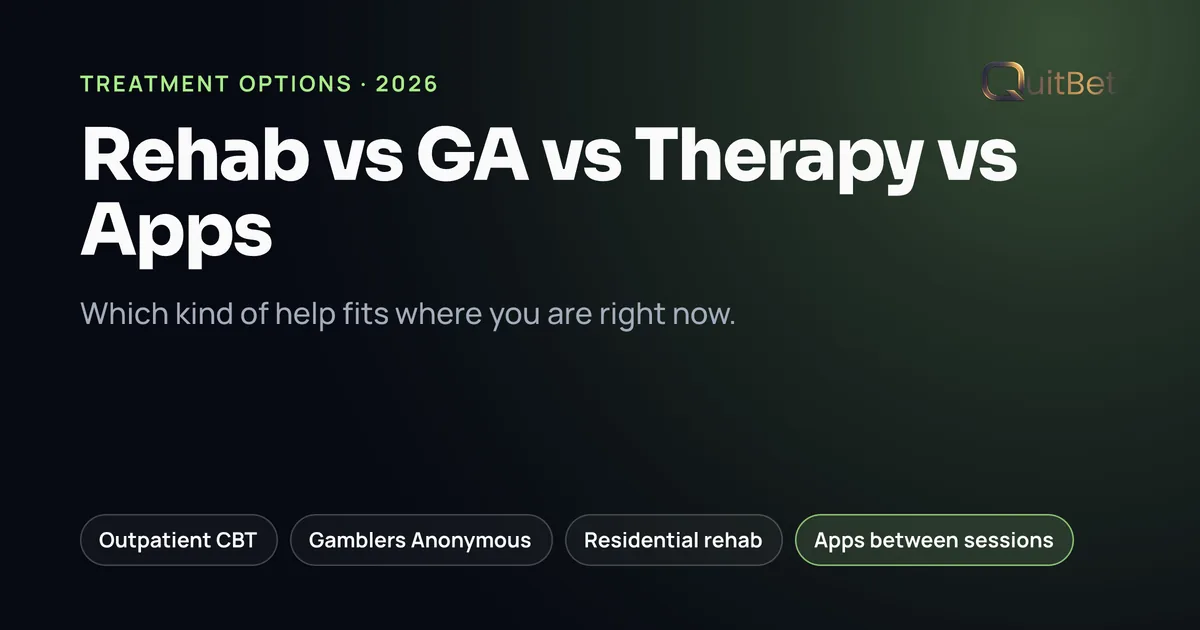
From most to least intensive, the main options are residential rehab, intensive outpatient, outpatient therapy, telehealth, Gamblers Anonymous, medication, and apps and blockers.
| Option | What it involves | Cost | Time commitment | Best for | What the evidence says |
|---|---|---|---|---|---|
| Inpatient or residential rehab | Living at a center with 24-hour support, therapy and groups | Rarely published; Algamus quotes after an insurance check. No cost in California | About a month (Algamus: 30 days minimum) | Outpatient care hasn't worked, other addictions, or an unworkable home | Few studies. In one German follow-up, 41.6% were fully abstinent a year later |
| Intensive outpatient (IOP) | Several long sessions a week while living at home | Varies; ask about insurance. No cost in California | California's model: 3-hour sessions, 3 days a week | More than weekly help while keeping a job | Few gambling studies; ask the program for its results |
| Outpatient therapy (CBT) | Weekly sessions with a licensed counselor | Varies; ask about insurance. Up to 12 free sessions in North Carolina | Weekly, often for about 3 months | Most people, as a first step | Best evidence of the talk therapies; gains may fade after treatment |
| Telehealth therapy | Therapy by video from home | Birches Health says many clients pay $0 to $25 a session with insurance | Birches: 12 weeks | No local specialist, or privacy | Online programs worked in trials, best with a therapist involved |
| Gamblers Anonymous | Free 12-step peer meetings in person, online or by phone | Free | As often as you like | Ongoing support at any stage | Mixed; a 2016 review called it inconsistent |
| Medication | Prescribed and monitored by a doctor | Varies by drug and insurance | As prescribed, with follow-ups | Strong urges, with a doctor's guidance | Nalmefene and naltrexone have the most support, with more side-effect dropouts than placebo |
| Apps and blockers | Phone tools that block gambling and help with urges | BetBlocker is free; Gamban is $41.99 a year | Minutes a day | Between sessions and late at night | Thin for consumer apps |
Prices checked October 2026.
How well does therapy for gambling addiction work?
Therapy helps many people, and cognitive behavioral therapy (CBT) has the strongest evidence of the psychological treatments studied for gambling. CBT teaches you to catch the thoughts that lead to a bet ("I'm due," "I'll win it back") and to plan for the situations that set you off.
A 2023 review of 29 randomized trials found a medium-sized drop in gambling severity after psychological treatment, and face-to-face therapy did best. The authors also warned that many trials had a high risk of bias and that long-term effects are still unclear (Eriksen et al., 2023). Another 2023 review, of CBT alone, found large gains right after treatment but no significant effect at later follow-up, and said the early numbers are probably inflated (Pfund et al., 2023).
Our read: therapy helps, but you have to protect the gains after the last session. That's where GA and a blocker earn their place.
Online programs help too. A meta-analysis of 13 trials found internet-delivered treatment reduced gambling symptoms, and programs with therapist support did better than self-guided ones (Sagoe et al., 2021).
How to find a gambling-specialist therapist
Pick someone who treats gambling specifically, so debt and chasing losses are familiar ground.
- Search NCPG's counselor directory, which lists counselors certified by the International Gambling Counselor Certification Board (IGCCB).
- Call or text 1-800-MY-RESET. NCPG says the helpline can connect you with help in your state.
- Check NCPG's help by state map. Some states pay for treatment.
- If nobody nearby fits, try telehealth (see below).
- Ask any therapist or gambling addiction treatment center how many gambling clients they've treated and whether they take your insurance or state funding.
How does Gamblers Anonymous work, and does it help?
Gamblers Anonymous (GA) is a free peer support group built on the Twelve Steps, and the research on how well it works is mixed.
The first GA group met in Los Angeles on September 13, 1957 (GA history). The only requirement is a desire to stop gambling. There are no dues, and newcomers sign nothing and pledge nothing (GA). Meetings run in person, online and by phone. Members talk about their past and present problems, work the steps, and can get a sponsor, an experienced member who helps one-on-one. GA says it isn't a religious society; members include people of many faiths, agnostics and atheists.
So does Gamblers Anonymous work? The research is thin and old. A 1988 Scottish study of 232 attenders found that 8% of all comers were completely gamble-free a year after their first meeting, and 7% after two years (Stewart & Brown, 1988). It counted only total abstinence, and it included everyone who came even once.
A 2016 review of 17 newer studies, mostly from the US, called the evidence for GA inconsistent, whether used alone or with treatment. The same reviewers called GA cost-effective and easy to access, which matters most for people with low incomes or gambling debt (Schuler et al., 2016).
We see GA as a partner to therapy rather than a rival. A therapist teaches you skills once a week. GA gives you people who've been where you are, and some of them will pick up the phone at midnight. If the 12 steps don't sit right, SMART Recovery holds free CBT-based meetings in person and online, though its site doesn't list gambling-only groups.
For partners and parents, Gam-Anon is a separate 12-step fellowship with no dues or fees. Its Pressure Relief Group meeting is meant to help families work out a livable budget that addresses all debts.
Can medication help with gambling addiction?
Some medications have helped in trials, but the evidence is limited, and only a doctor can say whether one fits you.
A 2025 network meta-analysis pooled 16 randomized trials with 977 people. Nalmefene reduced gambling severity compared with placebo. Naltrexone's effect on severity was smaller and not statistically significant, though it improved quality of life. Olanzapine and topiramate did no better than placebo, and people on nalmefene or naltrexone were more likely to drop out because of side effects (Ioannidis et al., 2025).
Ask your doctor or a psychiatrist, and bring a list of everything else you take.
Can you get gambling treatment online or for free?
You can get therapy by video almost anywhere in the US, and some states pay for treatment.
Birches Health offers video therapy for gambling and sports betting problems and says it works across all 50 states. Treatment follows a 12-week schedule, then a free peer recovery network. Birches says it's in-network with most major plans, including BCBS, UnitedHealthcare, Aetna and Cigna, and that many clients pay roughly $0 to $25 per session (Birches pricing). It doesn't publish a self-pay rate.
Kindbridge Behavioral Health, based in Denver, offers video therapy for gambling and sports betting, with a free 15-minute intake call. It lists therapists licensed in 49 states and Puerto Rico. Ask for a current price and whether it takes your insurance.
For free care, start with your state. North Carolina's Problem Gambling Program covers up to 12 confidential sessions at no cost, with no diagnosis required; call 877-718-5543 (NCDHHS). California's CalGETS covers outpatient, intensive outpatient and residential care at no cost. Anywhere else, 1-800-MY-RESET can tell you what's available where you live.
How long is gambling rehab, and what does it cost?
A residential stay usually takes about a month. Algamus requires at least 30 days and says most clients do best at around five weeks. Outpatient care is lighter but runs longer, often around 12 weekly sessions.
Price is harder. We couldn't find a published price for any gambling-specific residential program. Algamus gives a written estimate after checking your benefits, and it accepts most commercial plans (Aetna, BCBS, Cigna, UnitedHealthcare) but not Medicare or Medicaid.
NCPG calls gambling disorder a recognized mental health diagnosis, yet coverage still depends on your plan and state. Call the number on your insurance card and ask whether it covers gambling disorder, at which levels of care, and with which providers.
What happens if you relapse after treatment?
Relapse is common, and it doesn't cancel the progress you've made.
A German study followed 270 people for a year after inpatient treatment. At 12 months, 41.6% had stayed fully abstinent, 29.2% were gambling without meeting the criteria for gambling disorder, and 29.2% met the criteria again. All three groups were functioning better than before treatment (Müller et al., 2017). It's one German sample, and we couldn't find a reliable US relapse rate. Still, it shows that a slip and a full return to old habits aren't the same thing.
If you slip:
- Tell someone today, whether that's your therapist, your sponsor or a friend.
- Turn your blocks back on and close any account you reopened.
- Work out what set it off (payday, a big game, a fight, boredom) and plan for it.
- Get back to a meeting or a session. If slips keep happening, ask about stepping up a level of care.
Does a gambling problem raise suicide risk?
Yes. A 2024 meta-analysis of 107 studies found that 31.6% of people with gambling problems had thought about suicide at some point in their lives, and 13.2% had attempted it. Compared with people without gambling problems, their odds were about double for suicidal thoughts and nearly triple for attempts (Kristensen et al., 2024). The authors say these studies can't prove that gambling causes those thoughts.
If you're having thoughts of suicide, call or text 988 now. The 988 Suicide & Crisis Lifeline is free and confidential, day or night, and you can call about emotional distress before it turns into a crisis. Then tell your therapist or doctor, because it affects which level of care is right for you.
Which option is right for you?
It depends mostly on your safety and how much of your life gambling runs. Our default suggestion is outpatient therapy or telehealth plus GA and a blocker, stepping up if that isn't enough.
Talk to a clinician about inpatient or residential care if:
- you've tried outpatient therapy and keep relapsing
- you also have a drug or alcohol problem, or another mental health condition that's getting worse
- you've had thoughts of suicide (call 988 first)
- home makes quitting close to impossible, for example because someone you live with gambles
Intensive outpatient is the middle ground when weekly therapy isn't enough but you still need to work or look after family. Regular outpatient therapy suits you if you're still getting through the week. Choose video sessions if there's no gambling counselor nearby or you'd rather nobody saw you walk into an office.
GA works next to any of these, and it's especially useful if money is tight or your worst hours are nights and weekends.
Apps and blockers are the easiest thing to start tonight, but on their own they're a thin plan if gambling has already cost you savings or relationships. A Yale-led review of 14 gambling apps gave them an average quality score of 3.25 out of 5 (McCurdy et al., 2023).
For sports betting specifically, see our guide on how to stop sports betting. For online casino games, read how to stop casino addiction, and for slots, our guide to slot machine addiction.
How QuitBet can help
QuitBet is an iPhone app for people quitting gambling and sports betting. We built it for the hours between therapy sessions and GA meetings, including 2am, when nobody else is up.
You get a community forum and group chat, recovery lessons, urge tools with a panic button, daily check-ins for cravings and mood, an AI coach, and an app and website blocker. The blocker only covers the phone it's on, so add Gamban or BetBlocker if you also bet on a laptop (see how Gamban, BetBlocker and QuitBet compare).
QuitBet doesn't replace treatment, and it hasn't been tested in a clinical trial. It's free to download, with a subscription for most features, on iPhone only (iOS 18 or later) through the App Store. Our roundup of the best apps to quit gambling compares it with the alternatives.
FAQ
Can you go to rehab for gambling?
Yes, though options are limited. NCPG's directory lists seven US programs with a residential option, including Algamus in Arizona, and California's CalGETS offers a no-cost 30-day stay. Most people get help as outpatients instead.
Does insurance cover gambling rehab?
Sometimes. Algamus accepts Aetna, BCBS, Cigna and UnitedHealthcare but not Medicare or Medicaid, and telehealth provider Birches Health says it's in-network with most major plans. Coverage depends on your plan and state, so call your insurer and ask which levels of gambling treatment it pays for.
How long is gambling rehab?
Residential programs usually last about a month, and Algamus requires at least 30 days. Outpatient treatment often runs around 12 weeks or 12 sessions.
Does Gamblers Anonymous work?
It helps some people, but the research is mixed. A 1988 Scottish study found 8% of everyone who attended was fully abstinent a year later, and a 2016 review called the evidence inconsistent. Because GA is free and easy to find, it makes sense as a partner to therapy.
Is there medication for gambling addiction?
Some medications have helped in trials. A 2025 analysis of 16 trials found nalmefene and naltrexone had the most supportive evidence, though both led to more side-effect dropouts than placebo. Talk to a doctor or psychiatrist before trying anything.
What's the difference between inpatient and outpatient gambling treatment?
Inpatient (residential) treatment means living at a center with 24-hour support, usually for about a month. Outpatient gambling treatment means going to sessions, usually weekly, while you live at home and keep working. Intensive outpatient sits in between, with longer sessions several days a week.
Can I get free gambling addiction treatment?
In some states, yes. North Carolina covers up to 12 free sessions, and California's CalGETS covers outpatient, intensive outpatient and residential care. GA is free everywhere, and the free 1-800-MY-RESET helpline can tell you what your state offers.
Do I need rehab or is therapy enough?
For most people, outpatient therapy is the right place to start, ideally with GA and a blocker. Talk to a clinician about residential care if outpatient treatment hasn't worked, you also have a substance problem, you've had thoughts of suicide, or home makes quitting unworkable.
Need to talk to someone right now? Call or text 1-800-MY-RESET (1-800-697-3738), or chat online, to reach the National Problem Gambling Helpline. It's free and confidential, and it's open 24/7. If you're having thoughts of suicide, call or text 988.
This article is for information only and isn't medical advice. If you're struggling, talk to a doctor or a licensed counselor.