Quick answer: Contingency management is a treatment that gives people small rewards, such as vouchers or cash, each time they prove they stayed off a substance. It has strong evidence for quitting smoking. It has barely been tested for gambling, and cash prizes can feel like betting, so the safest parts to borrow are daily proof, quick rewards and support.
Getting help
Contingency Management: Can Rewards Help You Quit Gambling?
By QuitBet Addiction Research Team · Updated · 9 min read
On this page
Maybe you've heard that some people get paid to quit smoking and wondered whether that could work for gambling. Here's what the research says, including a 2021 study of a quit-smoking game called QuitBet.
One note before we start. The QuitBet in that study is a quit-smoking game made by WayBetter, Inc. It shares our name, but it's a different app from a different company, and we're not connected to it. This site is about QuitBet - Quit Gambling Now, an iPhone app for quitting gambling.
What is contingency management?
Contingency management (CM) is a behavioral treatment that rewards you every time you show objective proof of a goal, such as a clean drug test or a smoke-free breath test. The reward comes quickly, and only when the proof is there.
A 2022 study of UK gambling treatment providers describes the idea in three parts: pick a target behavior (showing up, staying abstinent or a step toward recovery), check it objectively, and give an incentive such as a voucher (Dorey et al., 2022). Quitting hurts right away, and the payoff usually shows up months later. CM puts a small, certain reward next to each good day.
There are three common versions:
| Type | How it works | Where it's been studied |
|---|---|---|
| Vouchers or cash | You earn a reward for each verified clean result | Smoking (Cochrane review, 2025) and drug treatment |
| Prize draws | Each clean result earns a draw with a chance at prizes of different sizes | Stimulant treatment (Petry et al., 2006) |
| Deposit contracts | You put up your own money and earn it back by staying quit | Smoking programs at work (Halpern et al., 2015) and in apps (Bloom et al., 2021) |
Does contingency management work?
For smoking, yes. A 2025 Cochrane review rated the evidence as high certainty.
The review pooled 39 randomized trials with 18,303 people. Those offered incentives were about 1.5 times as likely to have quit at six months or later as people who weren't (risk ratio 1.52, 95% CI 1.33 to 1.74). The benefit held up when the authors left out trials that were still paying rewards at follow-up, and they found no clear difference between small and large reward totals, which ranged from $45 to $1,185 (Notley et al., 2025).
For drugs, the UK gambling researchers describe CM as having a substantial evidence base for abstinence and attendance in substance use treatment (Dorey et al., 2022).
Do you have to put up your own money?
No, and most people prefer not to. In a trial with 2,538 CVS Caremark employees and their friends and family, 90.0% accepted a reward-only program, but only 13.7% accepted one that required a $150 deposit (Halpern et al., 2015).
Every incentive program beat usual care. Between 9.4% and 16.0% of people were still smoke-free at six months, compared with 6.0% on usual care. Deposits did work well for the few who signed up: among people willing to try either kind, the deposit programs had higher quit rates. Because so few people accepted them, though, the reward-only programs helped more people overall.
What did the QuitBet quit-smoking study find?
The QuitBet quit-smoking game helped about half its players make a serious quit attempt, and 95% of those surveyed said they would play again. Again, this is WayBetter's quit-smoking app, not ours.
Researchers from RAND, the University of Minnesota, the University of Florida, the University of Connecticut and WayBetter ran the pilot in October and November 2019 (Bloom et al., 2021). They recruited 50 US adults who smoked at least 10 cigarettes a day.
How the game worked
- Each player put up $30.
- The game lasted 28 days. Week one was for getting ready, and day 8 was quit day.
- From day 9 to day 28, players took a daily carbon monoxide breath test with a small personal monitor. Each smoke-free reading earned back $1.
- Unclaimed money went into a pot. Anyone smoke-free on at least 19 of the 20 days split it, so one slip didn't end the game.
- A game host posted every day with quitting tips or a discussion topic, and players could talk on a shared feed.
The results
| Measure | Result |
|---|---|
| Made a serious quit attempt (smoke-free readings two days in a row) | 26 of 50 (52%) |
| Smoke-free on at least 19 of 20 test days | 17 of 50 (34%) |
| Cut their smoking at least in half by the end | 25 of 50 (50%) |
| No smoking in the final week (self-reported) | 13 of 50 (26%) |
| Average cigarettes a day | 16.1 before, 8.5 after |
| Posted on the social feed at least once | 38 of 50 (76%) |
| Would play again and recommend it | 95% of the 37 who answered the survey |
Winners took home $74 in the first game and $105 in the second. Players rated the host's supportiveness 4.1 out of 5.
This was a small first test with no comparison group, so it shows the game was workable and well liked, not that it caused people to quit. Many players also used quit-smoking medication (40%), and most (90%) had played a WayBetter game before. NIDA and WayBetter funded the study, WayBetter helped design and write it, and the authors called for a larger randomized trial.
Does contingency management work for gambling?
We don't know yet. CM has hardly been studied as a gambling treatment. UK researchers wrote in 2022 that it has not been widely extended to gambling, and that more research is needed on whether it works (Dorey et al., 2022).
Two problems come up again and again.
There's no breath test for gambling. CM depends on objective proof. A carbon monoxide reading shows you didn't smoke, but nothing shows you didn't place a bet. Some of the 30 UK providers interviewed preferred rewarding therapy attendance over abstinence for this reason.
The rewards can look like the problem. The same providers said CM was similar in some ways to gambling. In a companion study of 25 people in gambling treatment, some worried that rewards could be used to get money to gamble, or that the reward system itself could trigger a relapse. Others thought incentives could keep people in treatment and bring them in sooner, and the group broadly supported the idea (Dorey et al., 2022b).
What about prize draws? In a study of 803 people in stimulant treatment, prize-based CM didn't increase gambling (Petry et al., 2006). But those patients were in drug treatment, not trying to quit gambling.
Our view: if you're quitting gambling, don't put money on your own recovery. A deposit you might lose or a pot you win from other people's losses runs on the same loop you're trying to break. So does a bet with a friend that you'll stay quit.
What can you borrow from contingency management to quit gambling?
The parts that don't involve money carry over well. These come from the research and from the WayBetter game:
- Count every day. CM pays out for each verified day, long before the finish line. Mark each gambling-free day on our 30-day recovery calendar or in an app.
- Find your closest thing to proof. Without a breath test, honesty is the check. Some people share their bank statements with a partner or counselor each week. Our guide on how to tell your partner about gambling has scripts for starting that conversation.
- Make the reward quick and certain. Pick small non-cash rewards for milestones, like a meal out after a week or a new pair of running shoes after a month. Don't use lottery tickets or scratch-offs.
- Watch the money you kept. The money you didn't bet is your reward. Our gambling loss calculator shows what gambling has cost you, so the savings feel real.
- Add people. The smoking game had a daily host and a shared feed. In gambling recovery, that role goes to Gamblers Anonymous, a counselor or a recovery community.
- Plan for a slip. The smoking game allowed one lapse day out of 20. One bad day doesn't erase the others, so restart the next morning. Keep the 10-minute urge timer handy for the hard moments.
If you're in counseling, ask your therapist whether they use rewards for attendance or milestones. Therapy for gambling addiction, most often CBT, has the most research behind it, and these ideas fit alongside it.
How does QuitBet use these ideas for gambling?
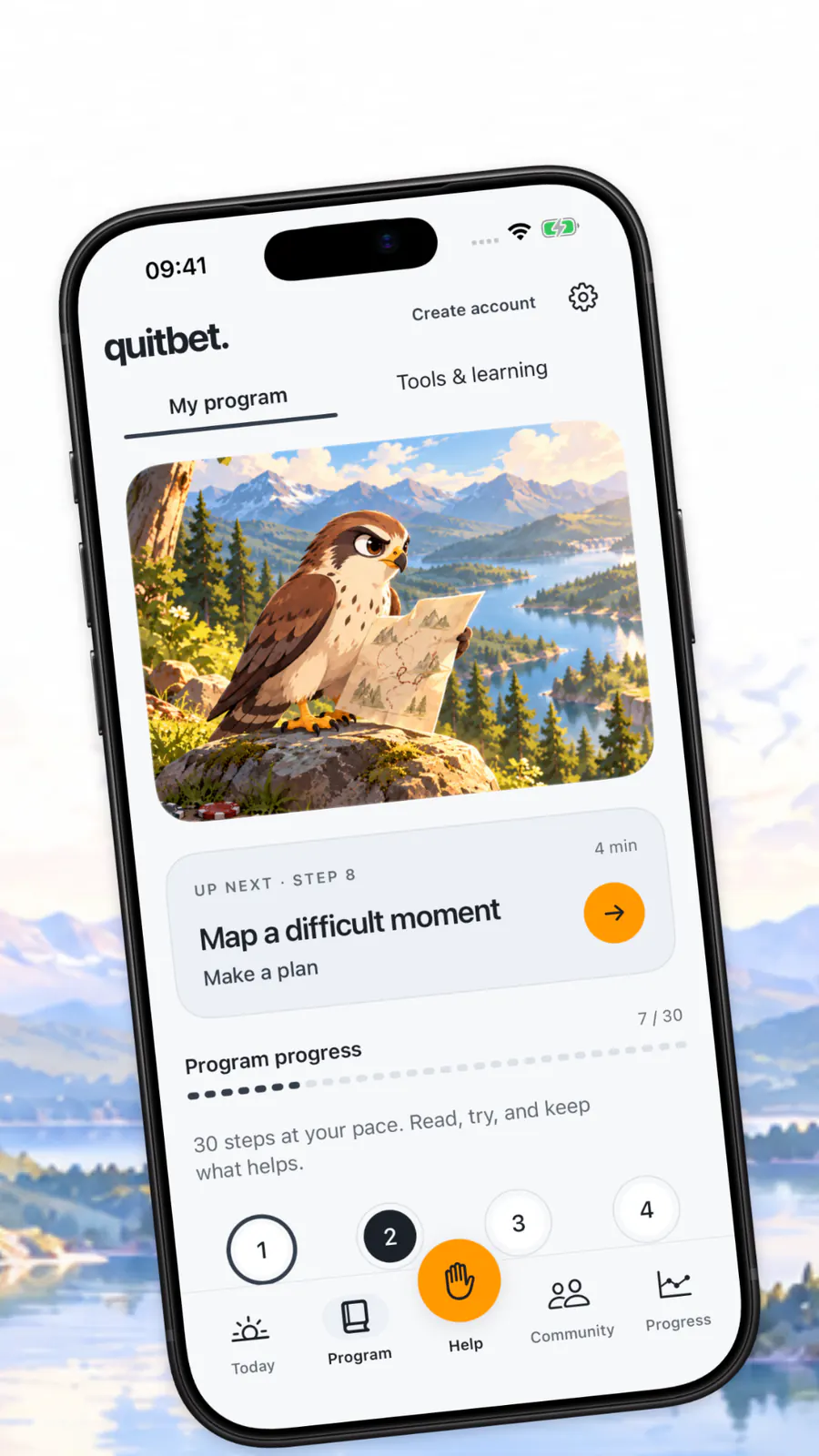
QuitBet - Quit Gambling Now is an iPhone app (iOS 18 or later) for quitting gambling. Like the WayBetter game, it's built around daily progress and support. Unlike that game, it has no deposits, bets or prize pots. Our app wasn't part of the WayBetter study.
QuitBet uses the parts of the approach that don't involve money:
- Daily check-ins to log cravings and mood.
- Streak, milestone and money-saved tracking, so you can watch the reward build.
- A recovery community where people share progress and keep each other going.
- A Learn section with recovery articles, podcasts and videos.
- A panic button, urge exercises and an AI coach for the moments a bet feels close.
- A Screen Time blocker for gambling apps and betting sites.
QuitBet is free to start. It works alongside therapy, GA or treatment, not in place of them. For other options, see our guide to apps for quitting gambling and our comparison of rehab, GA and therapy. If you're starting today, begin with our first-day plan to stop gambling.
FAQ
What is contingency management in simple terms?
Contingency management is a treatment that rewards you each time you prove you met a goal, such as a smoke-free breath test or a clean drug test. The rewards are small and immediate, like vouchers, cash or prize draws. It works by making each good day pay off right away.
Does contingency management work for gambling addiction?
It hasn't been tested enough to say. CM has strong evidence for smoking and solid evidence in drug treatment, but UK researchers noted in 2022 that it has rarely been used for gambling. Gambling is also hard to verify, since there's no breath or urine test for a bet.
Is the QuitBet smoking app the same as the QuitBet gambling app?
No. The QuitBet in the 2021 study is a quit-smoking game from WayBetter, Inc. QuitBet - Quit Gambling Now is a separate iPhone app for quitting gambling, made by a different team, and the two aren't connected.
Is contingency management a form of gambling?
Prize-draw CM does involve chance, which is why some gambling counselors are wary of it. A study of 803 people in stimulant treatment found it didn't increase their gambling. For someone recovering from gambling, rewards with no chance involved are the safer choice.
Can I use contingency management on myself to stop gambling?
You can borrow the idea: track each gambling-free day and reward milestones with something small that isn't money. Avoid deposits, pots or bets on your own recovery. If you have a counselor, ask whether they use rewards for attendance or milestones.
How big do the rewards need to be?
Not very big. The 2025 Cochrane review of quit-smoking incentives found no clear difference between programs with small and large reward totals, which ranged from $45 to $1,185. Getting a reward quickly and reliably seems to matter more than the amount.
Can you get paid to quit smoking?
Some programs do pay people to quit, through workplaces, clinics and research studies. The 2025 Cochrane review found that incentives made people about 1.5 times as likely to stay quit for six months or longer. Ask your doctor or employer what's offered near you.
Need to talk to someone right now? Call or text 1-800-MY-RESET (1-800-697-3738), or chat online, to reach the National Problem Gambling Helpline. It's free and confidential, and it's open 24/7. If you're having thoughts of suicide, call or text 988.
The QuitBet app
Keep your daily plan close
QuitBet for iPhone brings your quit plan, check-ins, gambling blocking and urge tools together.
- A panic button for the moment an urge hits
- Daily check-ins, streaks and money saved
- A blocker for gambling apps and websites
- A community of people quitting too
Download on the App Store
On a computer?Scan with your iPhone camera to get QuitBet.
Rated 4.4 on the App StoreFree to start on iPhone.