Quick answer: You can't make someone stop gambling, but you can help. Pick a calm moment, describe what you've seen and offer one specific kind of help. Don't pay their gambling debts. Protect shared money and your credit. Get support for yourself through Gam-Anon or 1-800-MY-RESET, which loved ones can call too.
For family & friends
How to Help Someone With a Gambling Problem: A Guide for Family
By QuitBet Addiction Research Team · Updated · 11 min read
On this page
- Can you stop a gambler from gambling?
- What are the signs someone has a gambling problem?
- How do you talk to someone about their gambling?
- What should you avoid saying or doing?
- Do family approaches like CRAFT actually work?
- How do you protect your money from someone's gambling?
- What if they refuse help or relapse?
- What gambling support groups help family members?
- How to help someone with a gambling problem this week
- Where do blockers and apps fit?
- FAQ
This guide is for the partner, parent, adult child or friend of someone whose gambling is hurting the family. It covers how to help someone with a gambling problem without losing your own savings or sleep. You'll find words to use, money steps to take this week and free US support for you.
Can you stop a gambler from gambling?
No, you can't make the decision to stop for another adult. You can change what gambling costs you, stop covering for it and make help easier to reach when they're ready.
That's hard to hear when you're the one watching the money disappear. You still control a lot around the gambling, starting with what you pay for and whether you get support yourself.
According to the American Psychiatric Association, only one in ten people with gambling disorder seek treatment. So if your loved one isn't ready yet, you're not alone, and your effort still counts.
What are the signs someone has a gambling problem?
The clearest signs are hiding gambling, chasing losses and needing other people's money to get out of trouble. You don't need to diagnose anyone to act on what you've seen.
Clinicians use the DSM-5 definition of gambling disorder: four or more of nine criteria within 12 months, causing real distress or harm. The Nevada Council on Problem Gambling reproduces the full list. In daily life, some of those criteria look like this:
- Money missing, new debts or bills that suddenly go unpaid.
- Lying about where time or money went.
- Betting again to win back what was lost.
- Asking you or others to cover a "short-term" problem.
- Getting restless or irritable when trying to cut back.
- Promising to stop, then starting again.
- Gambling to escape stress, sadness or boredom.
Only a licensed clinician can diagnose gambling disorder. What you've seen is still enough reason to talk.
How do you talk to someone about their gambling?
Talk when you're both sober, calm and have time, and lead with what you've seen and how it affects you. One conversation won't settle everything, and it doesn't need to.
Before you start:
- Pick a private time that isn't during a game, right after a loss or when either of you has been drinking.
- Write down two or three facts, such as dates, amounts or missed bills.
- Decide on one thing you'll ask for, and one limit you'll hold.
- Have a support number ready to share, such as 1-800-MY-RESET.
Some words you could adapt:
"I've noticed money missing from our account twice this month, and the electric bill went unpaid. I'm scared, and I'm not trying to attack you. Can we talk about what's going on with the betting?"
"I love you, and I'm worried about you. I'm not going to pay off any more gambling losses. I will sit with you while you call the helpline, tonight or tomorrow."
"You don't have to agree with me right now. I just need you to know what I've seen. I'm going to a support meeting for families this week, for me."
If they get defensive, you can pause: "Let's stop for now. I'll bring it up again this weekend." Pausing keeps the next talk possible.
If the person who gambles wants to come to you first, our guide on how to tell your partner about gambling covers the conversation from their side.
What should you avoid saying or doing?
Avoid lectures, threats made in anger, and paying off losses to make the problem go away. Each one feels like help in the moment but tends to make things harder.
Lectures and labels ("you're a degenerate," "you're a liar") tend to make people defensive rather than honest. Threats made in a fight, like "I'm leaving if you bet again," are hard to follow through on. If you set a consequence, choose it calmly and only if you plan to keep it.
Bailouts are the hardest one. Relying on others for money to fix a desperate situation is itself one of the nine DSM-5 criteria. Family-therapy researchers note that paying a gambler's bills can remove the natural consequences that might push them to change.
Other things that usually backfire:
- Covering for them with work, family or creditors.
- Checking their phone in secret.
- Gambling with them "so they don't go alone."
- Taking all the blame on yourself.
Do family approaches like CRAFT actually work?
Some research supports CRAFT for families of people who gamble, but the studies are small and the results are mixed. In trials it was linked to fewer gambling days and more satisfied family members, but it hasn't been shown to get more people into treatment.
CRAFT stands for Community Reinforcement and Family Training. As the 2016 study authors describe it, family members learn to reward gambling-free time, let natural consequences happen and communicate better. It also covers safety precautions and the family member's own well-being.
In a 2007 randomized trial in Canada, 186 family members (82% women, 56% spouses) got a CRAFT-based workbook, the workbook plus phone support, or an information package. All three groups improved at 3 and 6 months. The CRAFT groups did better on days gambled and on satisfaction, but there was no difference in how many gamblers entered treatment.
A 2016 trial with only 31 participants compared one-on-one CRAFT (8 to 12 hour-long therapist sessions) with the workbook. The difference wasn't statistically significant. The one-on-one group trended toward fewer days and dollars gambled and better family well-being. The authors call this "initial, but limited, support."
The UK's NICE gambling guideline (2025) recommends that services offer family members help on their own or together with the person who gambles if both agree. That help includes ways to manage their own distress and to communicate without judgment. NICE's committee also found no evidence that any one family program reduces gambling harm. NICE is UK guidance, not a US directory, but its advice fits here.
A counselor trained in CRAFT or family support can help you, whether or not your loved one ever joins. Our guide to therapy for gambling addiction explains what to ask a therapist.
How do you protect your money from someone's gambling?
Separate what you can, check your credit, and don't take on new debt for them. You can do all of this calmly and without asking permission.
Should you pay their gambling debts?
In most cases, no. Paying gambling debts can take away a reason to change, and it puts your own security at risk. If a debt is in both your names, though, you may already owe it. The CFPB explains that a joint credit card holder is responsible for the debt, while an authorized user generally isn't.
If a joint bill is at risk, deal with that specific bill with the creditor or a counselor. Our gambling debt guide has a call script and a money worksheet. For questions about who legally owes what, ask legal aid or an attorney.
Steps to protect your finances
- Open an account in your own name for your paycheck and essentials.
- Ask your bank what each joint account holder can withdraw or borrow, and whether you can lower limits or remove overdraft.
- Remove the person as an authorized user on your cards if they've used them for gambling.
- Pull your credit reports. The FTC says you can check them once a week for free at AnnualCreditReport.com, the only official site.
- Freeze your credit with all three bureaus. A credit freeze is free, lasts until you lift it, and stops anyone, including you, from opening new credit in your name.
- Keep important cards, checkbooks and valuables somewhere private.
What if you feel unsafe?
If you're afraid of your partner, your safety comes before any money conversation. Financial abuse can include a partner taking your earnings, controlling all spending or using a joint account to track you, as the National Domestic Violence Hotline describes.
You can call the hotline at 800-799-7233 or text START to 88788, 24/7. Use a phone or computer you believe is safe. In immediate danger, call 911.
What if they refuse help or relapse?
Keep your limits, keep your own support and leave the offer of help open. Refusal now doesn't mean refusal forever, and a relapse doesn't erase progress.
A boundary describes what you will do. "You have to stop" is a demand you can't enforce. "I won't lend money while you're gambling" is a boundary, because you control it.
Boundaries families often hold:
- "I won't pay gambling debts or lend money."
- "I won't lie for you to work or family."
- "My paycheck goes into my own account."
- "I'll talk about this when you're sober and calm, not mid-game."
- "I'll go with you to a meeting or appointment whenever you're ready."
If they relapse after a stretch of not gambling, try to respond to what happened without reopening every past hurt. You might say: "I'm upset, and my limits haven't changed. Who are you going to call today?"
If your loved one talks about suicide or not wanting to live, call or text 988 with them, or call 911 if they're in immediate danger.
What gambling support groups help family members?
Free US support for family members includes Gam-Anon, SMART Recovery Family & Friends and the national helpline. Some states also fund counseling for family members.
| Support | Who it's for | Cost | Format |
|---|---|---|---|
| Gam-Anon | Anyone affected by someone else's gambling | No dues or fees | 12-step meetings, in person and virtual |
| SMART Recovery Family & Friends | People whose loved one struggles with gambling, alcohol, drugs or other behaviors | Free meetings | Online and in person, trained facilitators |
| 1-800-MY-RESET | People who gamble and their loved ones | Free; no insurance needed | Call, text or chat, 24/7 |
| Washington State program | Washington residents, including family members | Free for eligible people | Assessment and treatment |
| Arizona TAP | Family members and others affected, as well as gamblers | State-funded | Treatment providers, phone counseling may be available |
Gam-Anon says you can attend even if your loved one is still gambling. It also describes a Pressure Relief Group that helps families build a livable budget around gambling debts.
The NCPG helpline says loved ones and family members can contact it for resources, including financial counseling. To find your own state's program, use NCPG's help-by-state map.
If your loved one is open to peer support, our Gamblers Anonymous guide explains how GA meetings work.
How to help someone with a gambling problem this week
Start with your own support and money, then plan one calm conversation. Steps 1 to 4 don't need anyone's agreement.
- Call or text 1-800-MY-RESET and say you're a family member. Ask what help exists in your state.
- Find one Gam-Anon or SMART Family & Friends meeting this week, in person or online.
- Pull your credit reports and freeze your credit if gambling debts might touch your name.
- Move your paycheck and essential bills to an account only you control.
- Write down two facts and one request for the conversation.
- Have the talk at a calm time, using your own words or the examples above.
- Decide on one boundary you'll keep, and say it once, calmly.
- Check in with your own support afterward, however the talk went.
Where do blockers and apps fit?
Blocking tools and self-exclusion only work when the person who gambles chooses them. You can share the options. Setting them up behind their back can damage trust, and the person can often undo them.
In the state programs we checked, you can't sign someone else up for self-exclusion. In Pennsylvania, for example, the regulator says a person cannot place another person on its self-exclusion lists. Massachusetts' program also says only the individual may enroll.
If your loved one wants to act, these can help:
- Our blocker comparison of Gamban, BetBlocker and QuitBet explains how each tool blocks and what it costs.
- The free gambling blocker finder lists device steps and self-exclusion options by country.
- The printable quit-gambling checklist walks through accounts, blockers, money and support. It's a planning aid, not a treatment.
- Our roundup of apps to quit gambling compares recovery apps by features and price.
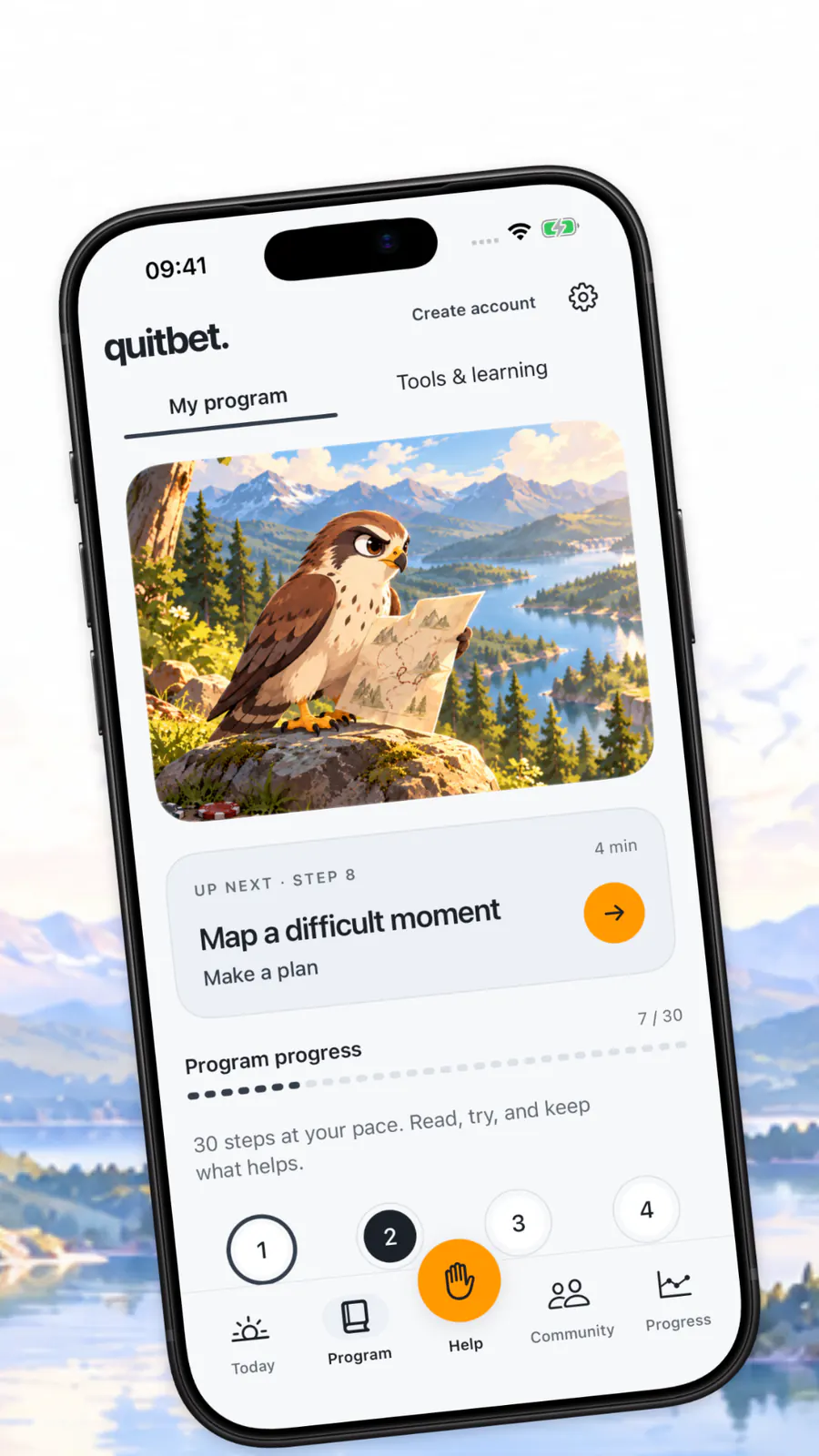
QuitBet is an iPhone app that combines a gambling blocker built on Screen Time with daily check-ins, urge tools, a panic button and a recovery community. It's free to start. It works alongside counseling, GA or treatment, and doesn't replace them. If your loved one decides to try it, QuitBet is on the App Store.
FAQ
Should I pay my husband's gambling debt?
Usually no, because paying it can take away a reason to change and puts your money at risk. If the debt is joint, you may already be responsible, so talk to the creditor or a credit counselor about that specific bill. For legal questions about who owes what, ask legal aid or an attorney in your state.
How do I help my son with a gambling problem?
If he's an adult, the same steps apply: talk calmly, don't pay his losses, and get support for yourself. Don't co-sign loans or hand over cash "just this once." You can call 1-800-MY-RESET as a parent to ask about help near you, and Gam-Anon welcomes parents too.
Can I ban someone from a casino?
In the state programs we checked, no. Self-exclusion has to be done by the person who gambles; Pennsylvania and Massachusetts both say another person can't enroll them. You can share the sign-up information and offer to go with them.
What is Gam-Anon?
Gam-Anon is a 12-step fellowship for people affected by someone else's gambling. It's separate from Gamblers Anonymous, there are no dues or fees, and you can attend even if your loved one is still gambling. Meetings are listed on its site, including virtual ones.
How do I deal with a gambling addict who keeps lying?
Focus on facts you can check, like statements and bills, rather than arguing about every story. Protect your own accounts and credit so the lies cost you less. A family support group or counselor can help you set limits you'll keep.
Can I call the gambling helpline if I'm not the one gambling?
Yes. NCPG says loved ones and family members can contact 1-800-MY-RESET for resources and referrals. It's free, confidential and open 24/7 by call, text or chat.
Is it my fault that they gamble?
No. The choice to gamble, and to get help, belongs to the person who gambles, and you can't control it on your own. What you can do is protect yourself, set clear limits and keep help within reach.
Need to talk to someone right now? Call or text 1-800-MY-RESET (1-800-697-3738), or chat online, to reach the National Problem Gambling Helpline. It's free and confidential, it's open 24/7, and family members and loved ones can call too. If you or the person you're worried about is having thoughts of suicide, call or text 988.
The QuitBet app
Keep your daily plan close
QuitBet for iPhone brings your quit plan, check-ins, gambling blocking and urge tools together.
- A panic button for the moment an urge hits
- Daily check-ins, streaks and money saved
- A blocker for gambling apps and websites
- A community of people quitting too
Download on the App Store
On a computer?Scan with your iPhone camera to get QuitBet.
Rated 4.4 on the App StoreFree to start on iPhone.