Quick answer: Is day trading gambling? Legally it's regulated securities trading, but for most people it works like gambling. Most day traders lose money, and problem gambling is several times more common among them. If you chase losses, trade bigger for the thrill or hide it, treat it as a gambling problem: stop, close the account and call 1-800-MY-RESET.
Types of gambling
Is Day Trading Gambling? How to Tell, and How to Stop
By QuitBet Addiction Research Team · Updated · 9 min read
On this page
- Is day trading gambling or investing?
- Do most day traders lose money?
- Is trading addiction a real thing?
- Why does trading feel like gambling?
- What are the signs trading has become a gambling problem?
- How do you stop day trading when it feels like gambling?
- How can an app help you stop trading like a gambler?
- FAQ
You open the app at 9:30 to make back yesterday's loss. By 10:15 the position is down, so you double it. By lunch you've lost a week's pay and you're looking at options that expire today, because they're the only thing that moves fast enough to get you even.
If that sounds familiar, this is for you. The short answer isn't comfortable: for most people who try it, day trading loses money the way betting does, and it can grow into the same problem.
Is day trading gambling or investing?
Day trading sits between the two, and for most people who do it, the money behaves like gambling money. Researchers who reviewed the definitions in the Journal of Behavioral Addictions concluded that gambling and investing are "conceptually distinct", and that speculation, which includes day trading, is "conceptually intermediate between gambling and investment" (Arthur, Williams and Delfabbro, 2016).
They define day trading as buying and selling stocks in the same day to profit from small price changes, and they note that "most day traders lose money over the long run" (Arthur et al., 2016).
Day trading is legal and regulated as a securities activity. Whether it's gambling for you depends less on the label and more on what it's doing to your money, your time and your head.
Do most day traders lose money?
Yes. The largest studies of real trading records find that only a tiny share of day traders make money year after year.
| Study | Who was tracked | What they found |
|---|---|---|
| Taiwan Stock Exchange, 1992 to 2006 | About 360,000 day traders in an average year | "Less than 1% of the day trader population is able to predictably and reliably earn positive abnormal returns net of fees" (Barber, Lee, Liu and Odean, 2014) |
| Brazilian equity futures, traders who started 2013 to 2015 | People who kept day trading for at least 300 days | 97% lost money, and only 0.4% earned more than a bank teller's pay of US$54 a day (Chague, De-Losso and Giovannetti, 2019) |
The Brazil study also found "no evidence of learning by day trading" (Chague et al.). Practice didn't turn losing traders into winning ones.
US regulators have said the same thing for decades. The SEC's investor guide on day trading says "day traders typically suffer severe financial losses in their first months of trading" and warns that people who trade on borrowed money can lose everything and "end up in debt as well" (SEC, 2005).
Is trading addiction a real thing?
Yes. Problem trading isn't a separate diagnosis in the DSM-5, but research keeps finding it alongside gambling problems, and gambling clinics treat it.
- In a South Australian survey of 9,245 adults, the rate of problem gambling was 7.6% among day traders, compared with 1.7% among people who didn't day trade (reported in Arthur et al., 2016).
- In Canadian data (samples of 8,498 and 4,121 adults), problem gambling was two to three times higher among high-risk stock traders than among gamblers who didn't trade high-risk stocks (Arthur et al., 2016).
- Among Spanish patients treated for pathological gambling, 76 had stock trading as a secondary problem and 18 had it as their main problem (Granero et al., 2012, reported in Arthur et al., 2016).
- A Rutgers study of 876 adults who gambled at least monthly found that people who traded both crypto and high-risk stocks reported more problem gambling, depression and anxiety than people who traded only one of them. The study's co-author Lia Nower said crypto traders "look very much like" people who trade high-risk stocks "such as margins and options" (Rutgers, 2019).
These are associations, not proof that trading causes gambling problems. The review's authors recommend that financial speculation be "routinely included when assessing gambling involvement" (Arthur et al., 2016). If you're worried about your trading, a gambling counselor is the right person to talk to.
Why does trading feel like gambling?
A trade settles in minutes and now and then pays big. That's the rhythm a slot machine runs on, too. Some of the pull comes from the stocks people pick, and some of it was designed into the apps.
Finance research found that individual investors "prefer stocks with lottery features", that demand for lottery-type stocks rises in economic downturns, and that state lotteries and lottery-type stocks "attract very similar socioeconomic clienteles" (Kumar, 2009, Journal of Finance). In that study of about 70,000 investors, people who took risks on lottery-type stocks earned 2 to 3 percent less than other investors (University of Texas at Austin).
App design matters too. In a January 2024 consent order, the Massachusetts Securities Division described Robinhood features that included "digital confetti raining down" after a customer's first trade, push notifications about price moves, popularity lists, and a free-stock offer that required customers "to mimic the motion of 'scratching off' a lottery ticket." Robinhood paid a $7,500,000 fine, neither admitted nor denied those allegations, and agreed to permanently stop features that "mimic games of chance" for Massachusetts customers (Massachusetts Securities Division).
What are the signs trading has become a gambling problem?
Trading has become a gambling problem when it shows the same signs clinicians use to diagnose gambling disorder. The DSM-5 lists nine. A diagnosis needs four or more in 12 months, rated mild (4 to 5), moderate (6 to 7) or severe (8 to 9) (DSM-5 criteria, Connecticut DMHAS).
Here's how some of those signs tend to look in a trading account. The examples are ours, not part of the criteria.
| DSM-5 sign | What it can look like in trading |
|---|---|
| Needing bigger bets for the same excitement | Moving from shares to options or margin because shares feel boring |
| Restless or irritable when cutting back | Checking the app on a day you promised not to trade |
| Repeated failed attempts to stop | Deleting the app, then reinstalling it the next morning |
| Chasing losses | Doubling a losing position to get back to even |
| Gambling when upset | Trading to escape a bad day or a fight at home |
| Lying to hide it | Keeping a second brokerage account your partner doesn't know about |
| Putting a job or relationship at risk | Trading during work meetings, or missing family time for the open |
| Relying on others to cover losses | Borrowing from family to cover a margin call or the rent |
Being profitable this month doesn't rule a problem out. The signs are about what trading is doing to you, not about your balance. If several of these fit, our guide to the signs of a gambling problem goes through all nine, and the National Council on Problem Gambling has a free self-assessment. It's a prompt to get help, not a diagnosis.
How do you stop day trading when it feels like gambling?
You stop by treating it like any other gambling problem: end the trading, remove the access and get support. A loss you're trying to trade back is the same as a loss you're trying to bet back, and our guide to chasing losses explains why that urge is so strong.
- Stop opening new trades today. Don't make big decisions about your long-term savings in the middle of a bad week. Day trading is the problem, not every dollar you have invested.
- Write down the real number. Add up what you've lost in trading, including fees and interest. Our free gambling loss calculator does the math.
- Close the account you day trade from. Contact your broker and ask them to close it, and take saved cards and bank links off any trading app. Closing it does for a trading app what closing a betting account does for a sportsbook.
- Block the apps. Delete them, then make a reinstall take real effort. On iPhone, Screen Time can stop new app installs and lock its settings behind a passcode (Apple; passcode). On Android, Digital Wellbeing can pause chosen apps behind a PIN. Let someone you trust set the passcode or PIN.
- Let someone else hold the long-term money for a while. A partner, a family member or a fee-only financial planner can be a second signature on any big move.
- Pay the essentials first. Rent, food, medicine and transport come before anything else. If trading left you in debt, our gambling debt guide covers the next steps. Never borrow to trade back a loss.
- Tell one person, or call the helpline. Call or text 1-800-MY-RESET (1-800-697-3738), the free, confidential National Problem Gambling Helpline (NCPG).
- Get treatment that targets the thinking. Cognitive behavioral therapy (CBT) has the strongest evidence base among psychological treatments for gambling problems, based on a 2023 meta-analysis of 29 trials (Eriksen et al., 2023). Our guide to therapy for gambling addiction explains how to find it.
If you also bet on sports or play online casinos, close those accounts at the same time. Our guide on how to stop online gambling walks through every layer, from state self-exclusion to blockers. And if losses have left you feeling hopeless or thinking about ending your life, call or text 988 for the Suicide & Crisis Lifeline right now.
How can an app help you stop trading like a gambler?
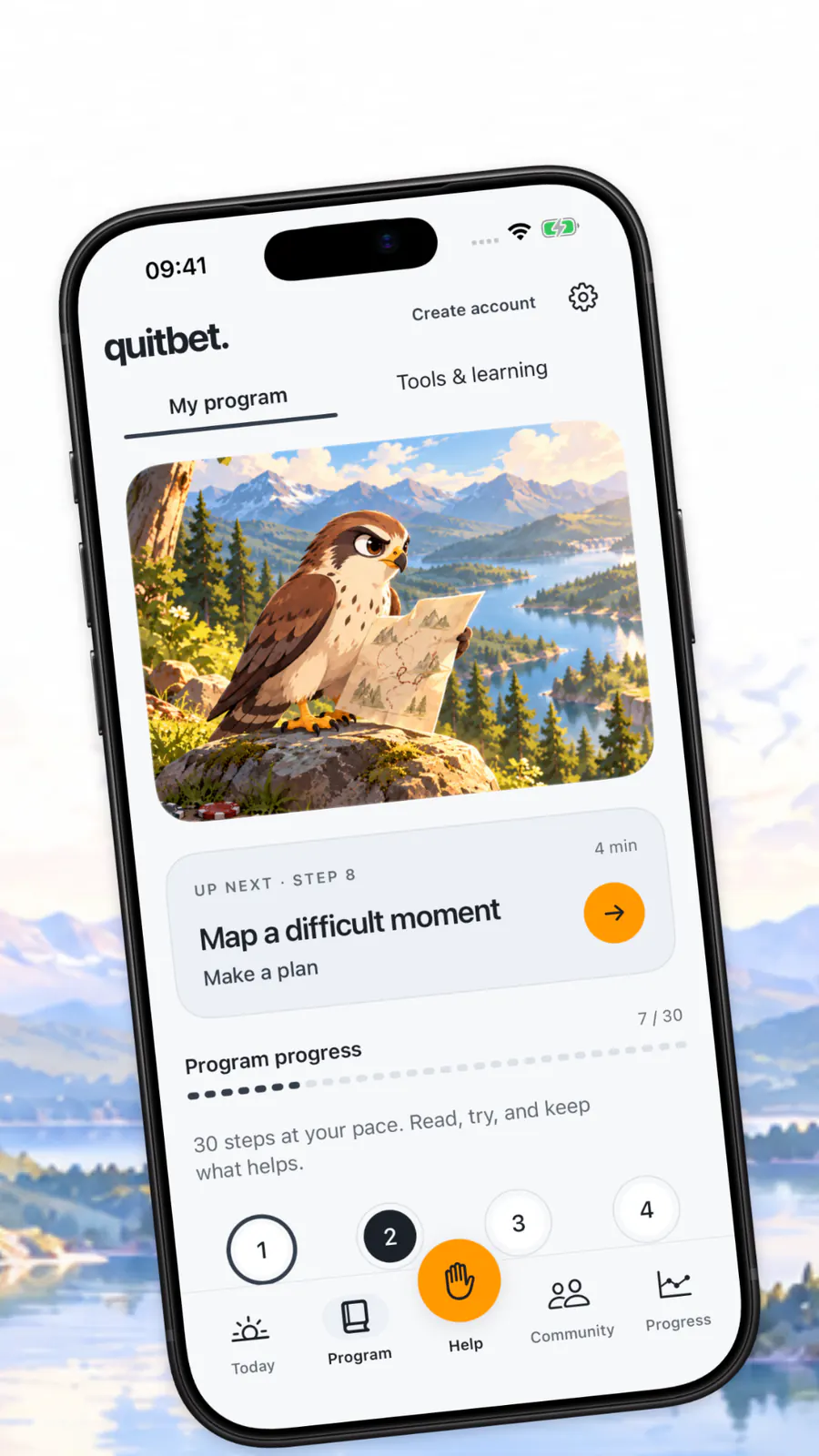
An app can't make the decision for you, but it can sit between the urge and the trade. QuitBet, the app we make, is for iPhone (iOS 18 or later) and Android. It blocks gambling apps and sites, has urge tools with short breathing and focus exercises for the moment the urge hits, and an AI chat for support when nobody else is awake.
QuitBet also has daily check-ins on urges and triggers, tracks your streak and the money you keep, and has a community of people who are quitting too. It's built for gambling, but the urge to place one more trade is the same urge, so the tools apply. It's free to start and works alongside therapy or Gamblers Anonymous, not in place of them.
FAQ
Is day trading considered gambling?
Legally, no: it's a regulated securities activity. In practice it often works like gambling. Researchers place day trading between gambling and investing, most day traders lose money over time, and problem gambling is more common among day traders than among other adults.
Is options trading gambling?
Options are regulated securities, not casino games. Buying short-dated options to catch quick price moves is high-risk speculation, and research groups options and margin trading with the high-risk stock trading that's linked to problem gambling. If you trade options for the rush or to win back losses, treat it as gambling.
Is the stock market just gambling?
No. Researchers who compared them concluded that gambling and investing are conceptually distinct. Buying and holding for years is a different activity from trading in and out within a day. The trouble starts when trading turns fast and the goal becomes winning back what you lost.
Can you get addicted to day trading?
Yes. Problem trading isn't its own diagnosis, but it can meet the DSM-5 signs of gambling disorder, such as chasing losses, hiding it and failing to stop. One Spanish study of people in gambling treatment included 18 whose main problem was stock trading.
What percentage of day traders lose money?
In Brazil, 97% of people who kept day trading for at least 300 days lost money. In Taiwan, fewer than 1% of day traders earned reliable profits after fees, across 15 years of exchange records.
Who can I talk to about a trading problem?
Call or text 1-800-MY-RESET (1-800-697-3738), the National Problem Gambling Helpline. It's free, confidential and open 24/7. A gambling counselor or a free Gamblers Anonymous meeting is a good next step.
Need to talk to someone right now? Call or text 1-800-MY-RESET (1-800-697-3738), or chat online, to reach the National Problem Gambling Helpline. It's free and confidential, and it's open 24/7. If you're having thoughts of suicide, call or text 988.
The QuitBet app
Keep your daily plan close
QuitBet for iPhone and Android brings your quit plan, check-ins, gambling blocking and urge tools together.
- Quick help for the moment an urge hits
- Daily check-ins, streaks and money saved
- A blocker for gambling apps and websites
- A community of people quitting too
On a computer?Scan with your phone camera to get QuitBet on iPhone or Android.
Rated 4.2 on the App StoreFree to start on iPhone and Android.